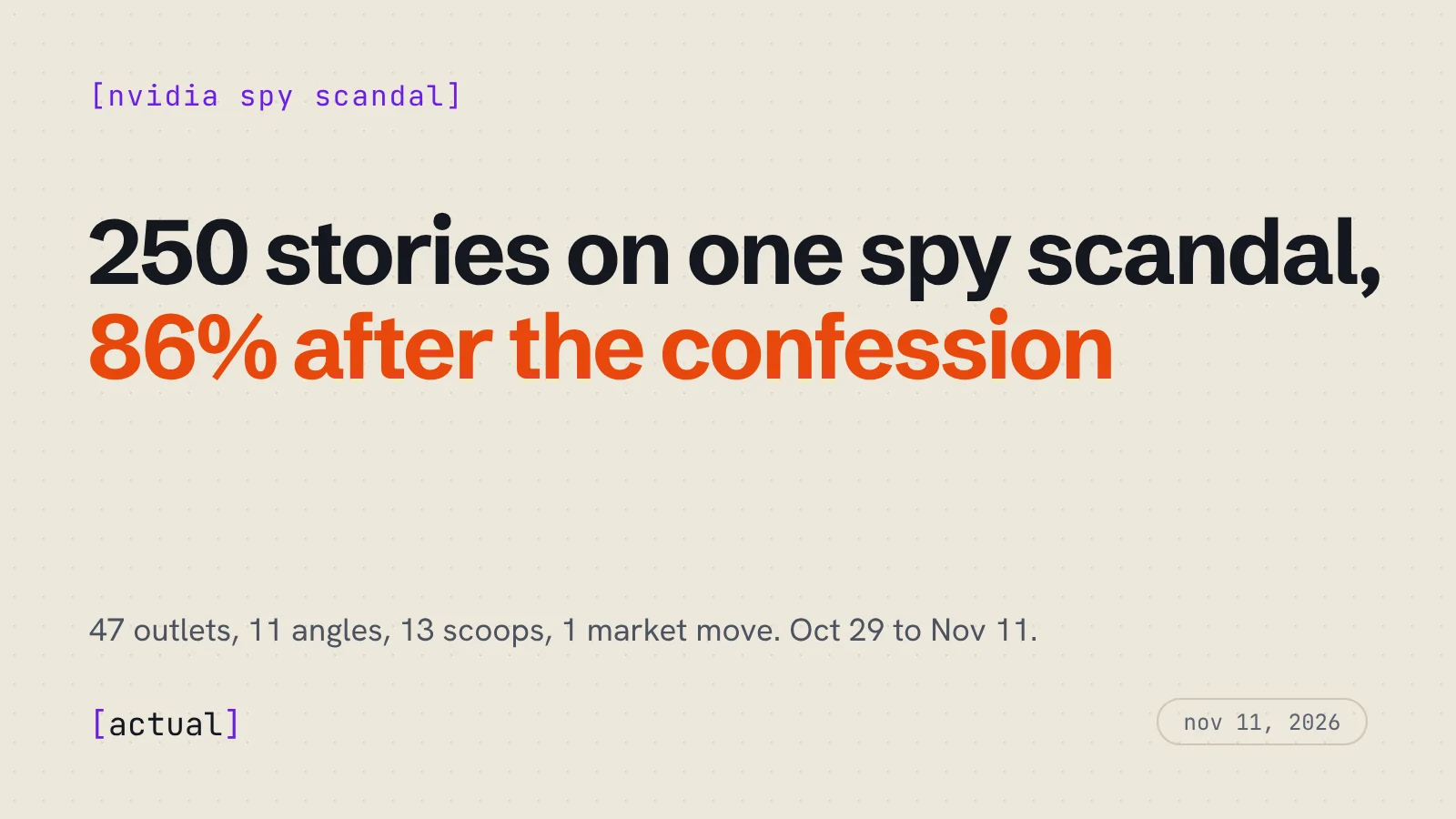
We analyzed 250 stories from 47 outlets on the Nvidia spy scandal, published between Oct 29 and midday Nov 11, 2026. This scan widens the net past the 50 AI reporters in the Nov 2 index to the wires, broadcasters, national papers, trade press, Asian outlets and independents. The story ran for ten days as a slow-building national security report. Then Huang confessed, and 86% of everything we found was published from that day on.
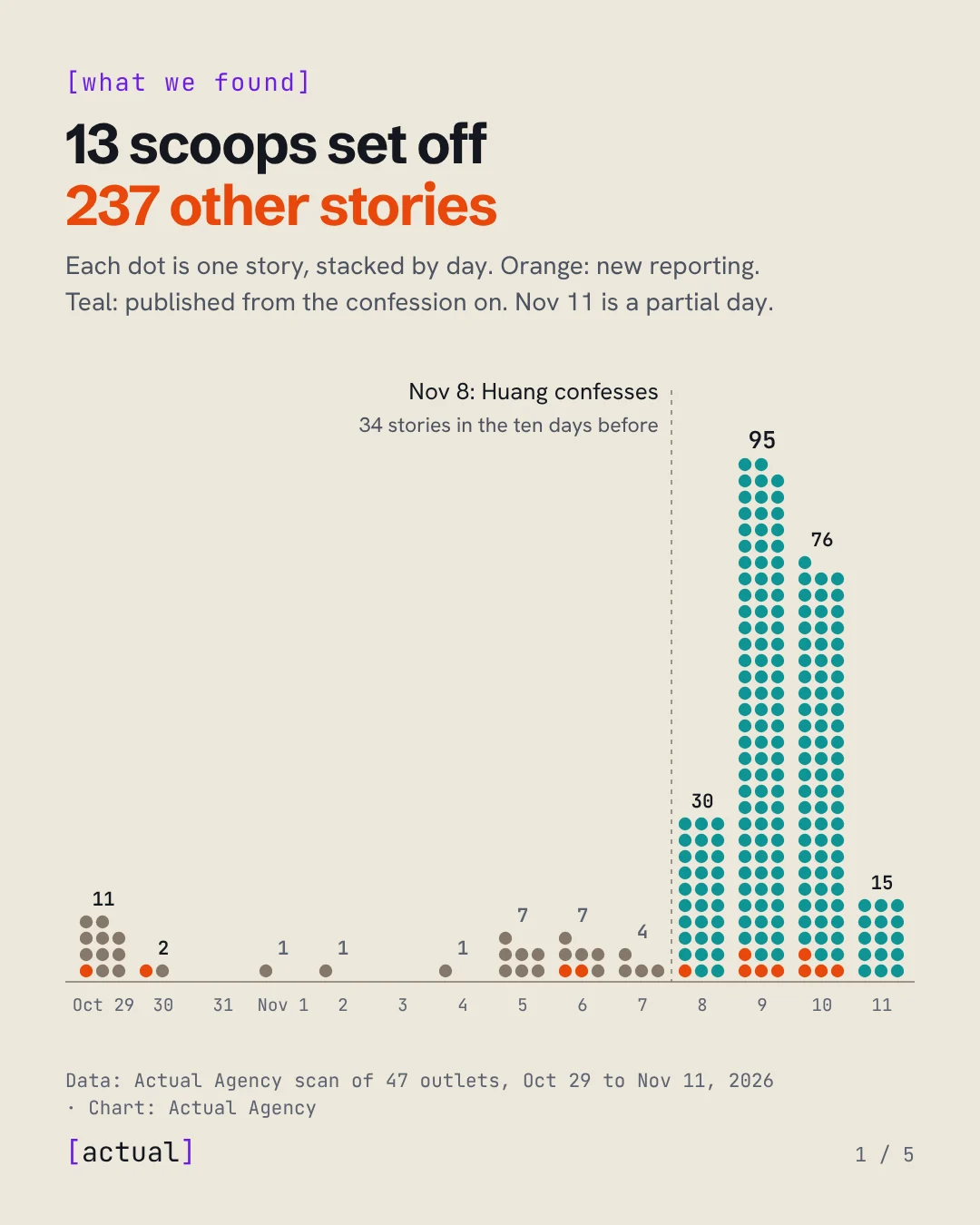
95 of 250 stories ran the day after the confession
The New York Times opened the story on Oct 29: US intelligence had concluded that Alice Huang, an executive at Nvidia customer Megaspeed, was passing information to Beijing and had a close relationship with Jensen Huang. We found 11 stories that day and 5 over the next six days. Nvidia called the contact "not unusual," and the midterms took the news cycle.
Coverage restarted on Nov 5 with a letter from three House committee chairs, and again on Nov 6 when the Times reported she was recruited by China's Ministry of State Security and the FT reported the relationship was romantic. On Sunday, Nov 8, Huang told employees he had been unfaithful to his wife and the board opened an independent investigation. Monday, Nov 9 produced 95 stories, 38% of the total, and Nov 10 another 76.
Explainers outnumbered every reported angle
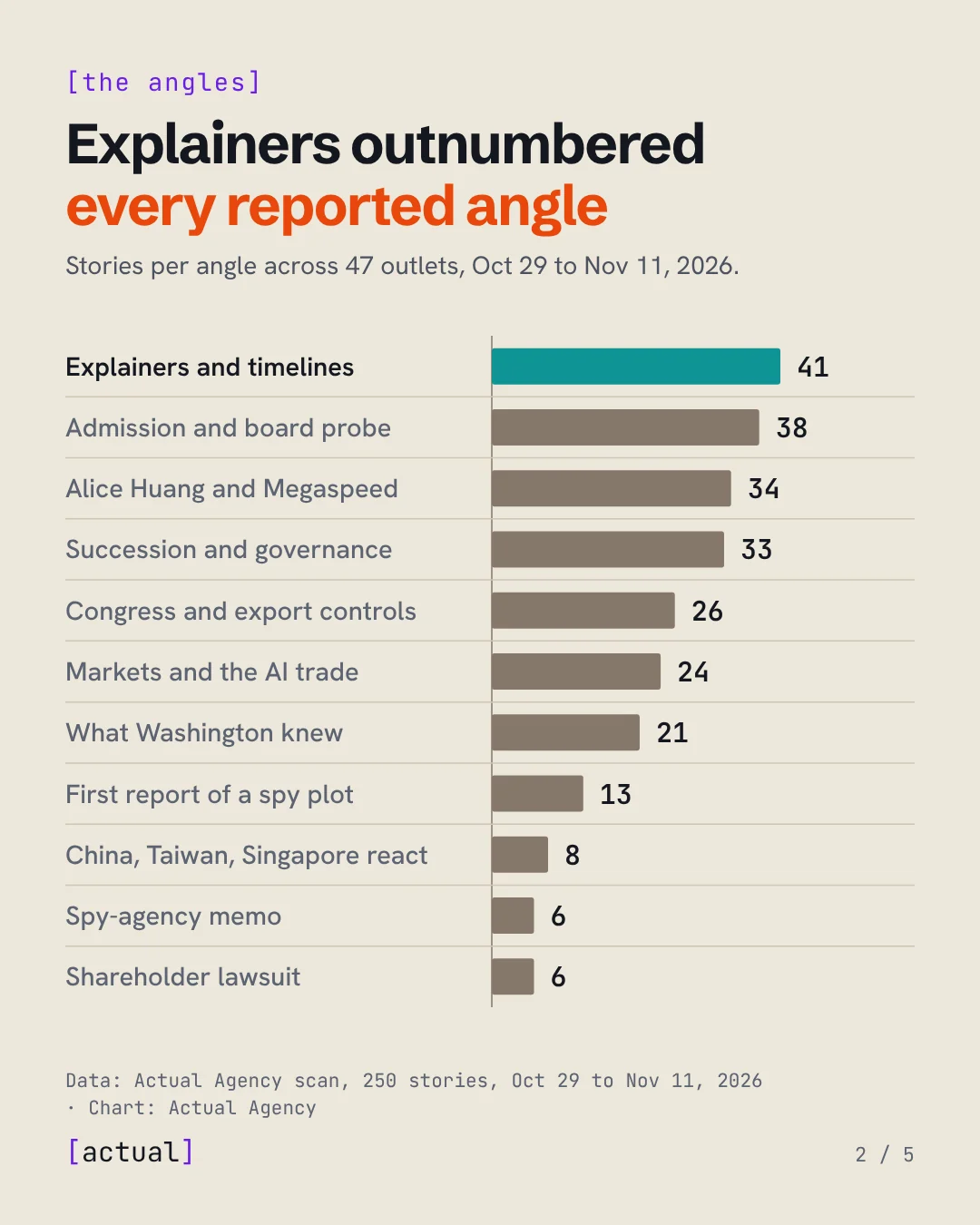
The largest category was not reporting. Timelines, what-we-know pieces, podcasts, profiles of the cast and meme roundups made up 41 of the 250 stories, more than three for every scoop. The admission and board probe drew 38 from 26 outlets, the widest reach of any angle.
Succession and governance drew 33 stories from 17 outlets, and none of it existed before Nov 8. Once Huang admitted the affair, the question outlets asked was who could run Nvidia without him: the company has no chairman, no public succession plan and about 60 executives reporting to the CEO. The WSJ, Bloomberg, the FT, the Times, CNBC, Fortune, Axios, The Information and Reuters Breakingviews all ran it.
Alice Huang and Megaspeed drew 34 stories and carried most of the new facts: the Commerce Department inquiry that stalled, the delayed blacklisting, and The Information's report of $7.5B in chips reaching Chinese firms. The policy angle, Congress and export controls, drew 26. It has the longest runway, with a House briefing requested for Nov 18 and three chip bills attached to the defense authorization package.
The Times broke 5 of the 13 scoops
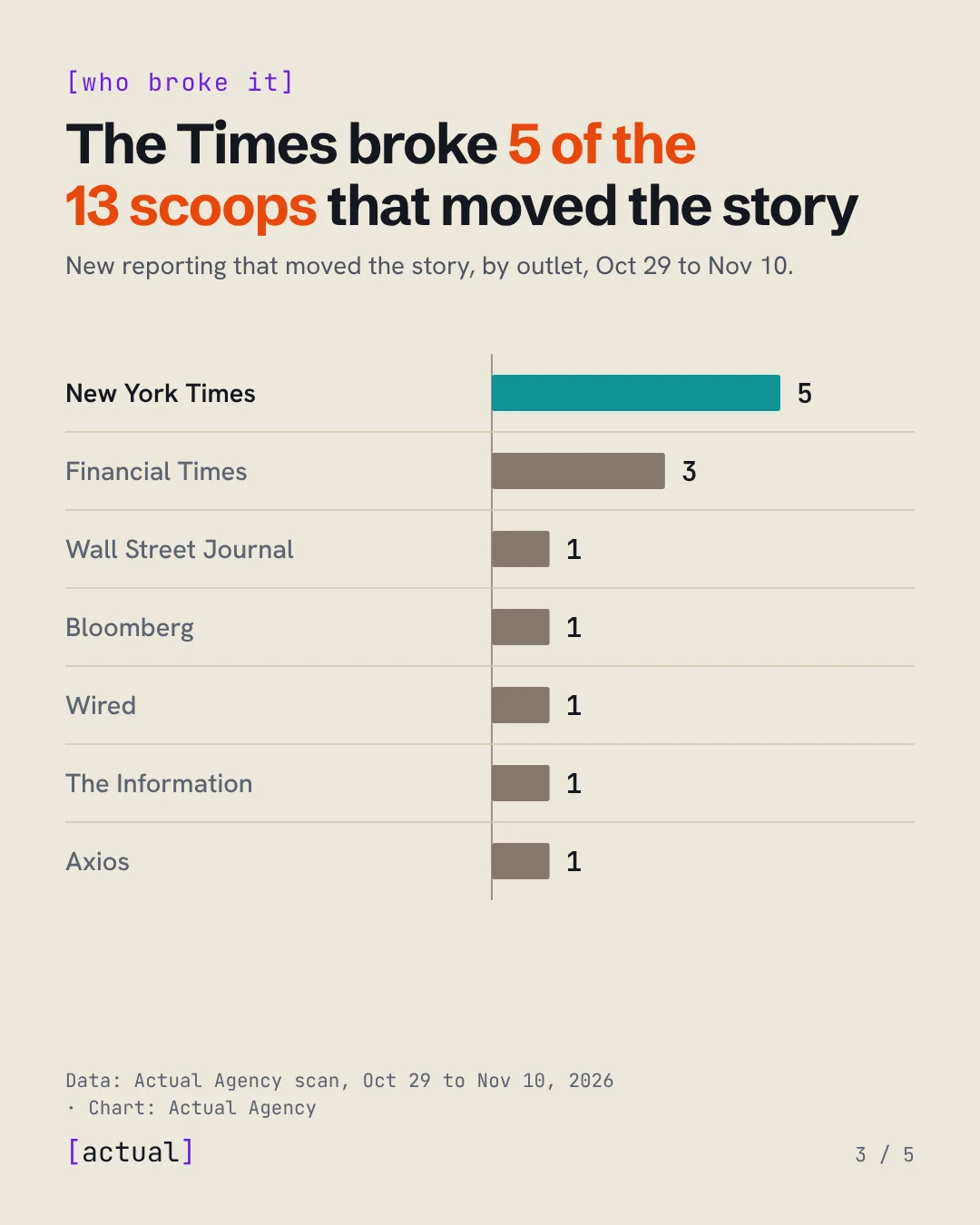
We counted 13 pieces of new reporting that moved the story. The Times had five: the first report (Oct 29), the spy-agency recruitment (Nov 6), Secretary of State Marco Rubio's classified memo (Nov 8), the Commerce inquiry that stalled after Nvidia's general counsel reached out (Nov 9), and Rubio's briefing of President Trump aboard Air Force One (Nov 10). The FT had three, including Alibaba's loans to Megaspeed and the Commerce Department's delay in blacklisting it. The WSJ, Bloomberg, Wired, The Information and Axios had one each.
Seven outlets produced all 13. The other 40 outlets, and 237 of the 250 stories, followed, explained or reacted. Four outlets (the Times, the WSJ, Bloomberg and the FT) account for 71 stories, 28% of the set.
The scoops came from national security, White House and China desks. The Oct 29 story carried six bylines: Jonathan Swan, Maggie Haberman, Ana Swanson, Paul Mozur, Tripp Mickle and Julian E. Barnes. Of the 50 AI reporters we track in the index, 18 covered the scandal in 24 pieces, mostly same-day write-ups of the admission, and none had a byline we could confirm on a scoop.
Nvidia fell 9.5% in two sessions as chip stocks rose
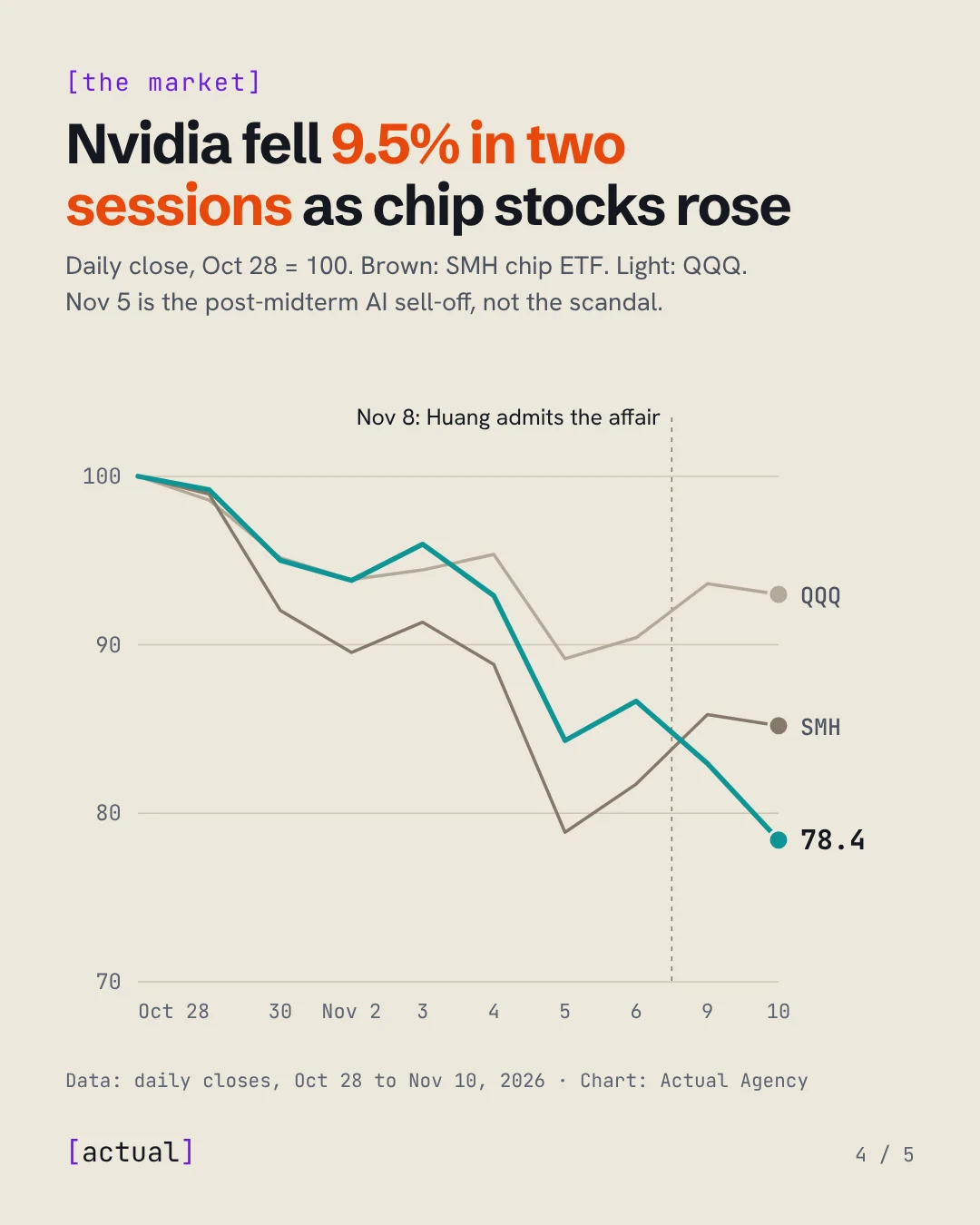
Nvidia closed down 4.3% on Nov 9 and 5.5% on Nov 10, a two-session drop of 9.5%. Over the same two sessions the SMH chip ETF rose 4.2% and QQQ rose 2.8%, so Nvidia trailed chip stocks by 13.7 points. Reuters put the Nov 9 loss at about $190B of market value. Yahoo Finance called it Nvidia's worst day during a chip rally of 5% or more since 1999.
The earlier decline is harder to read. From the Oct 28 close to Nov 6, Nvidia fell 13.3%, but it lost 12.1% in the two sessions after the Nov 3 midterms alone, when the whole AI trade sold off and SMH fell further than Nvidia. The scandal-specific gap opens only after the admission. Since Oct 28 Nvidia is down 21.6%, SMH 14.8% and QQQ 7.0%.
How fast the stories spread
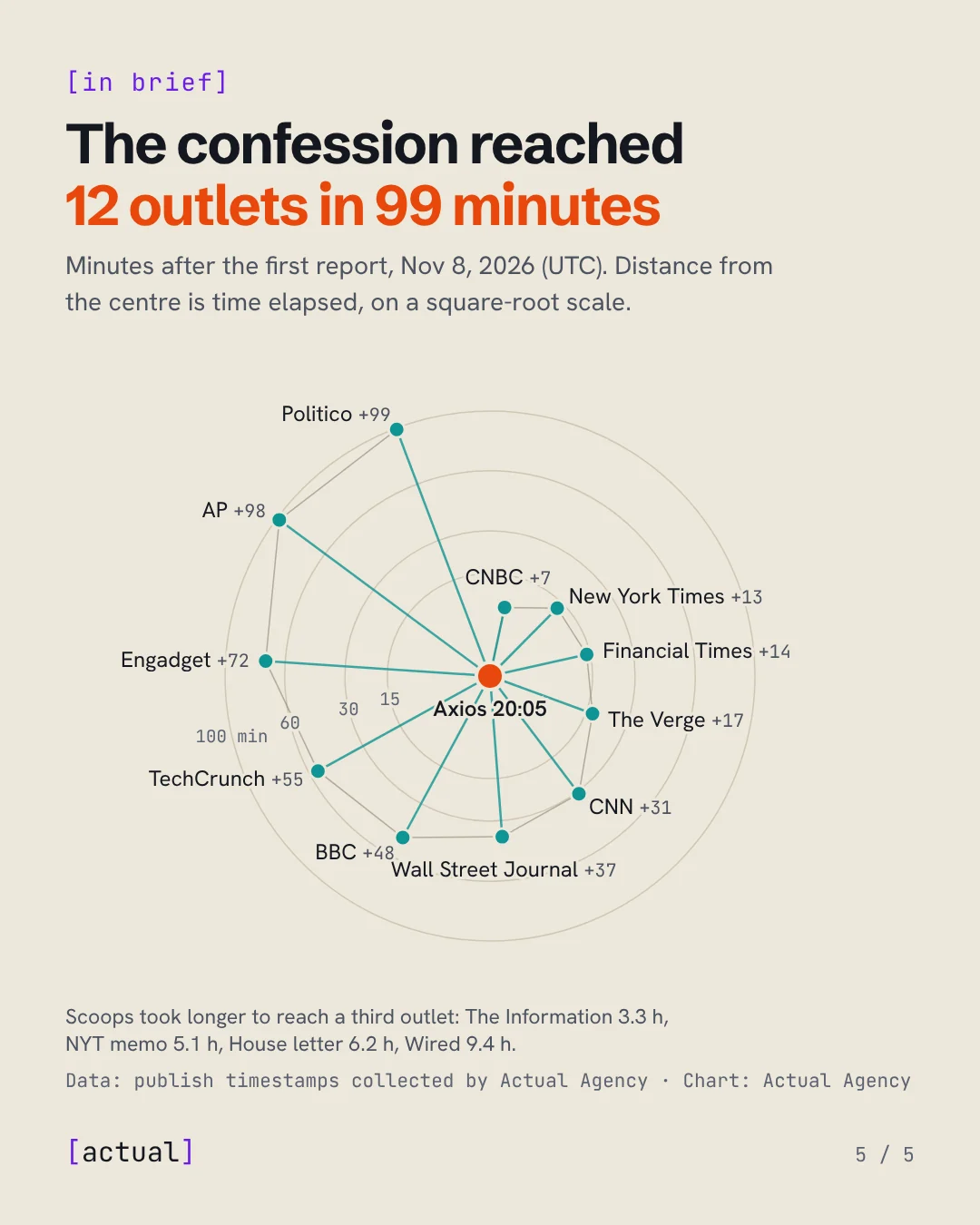
The company's own statement moved fastest. Axios had Huang's admission at 20:05 UTC on Nov 8, CNBC at 20:12 and the Times at 20:18. Twelve outlets had it within 99 minutes. Reported scoops travelled slower. The Times memo story took about five hours to reach a third outlet, and that outlet was the FT with its own reporting. Wired's item on the crisis PR firm took more than nine hours.
The 11 angles
| Angle | Stories | Outlets | Data point |
|---|---|---|---|
| Explainers and timelines | 41 | 22 | Timelines and explainers at the WSJ, Bloomberg, NYT, BBC, CNN, AP and TechCrunch |
| Admission and board probe | 38 | 26 | Board retained Wachtell and former acting US attorney Joon Kim on Nov 10 |
| Alice Huang and Megaspeed | 34 | 21 | Megaspeed affiliate bought at least $4.8B of Nvidia gear; The Information put linked sales at $7.5B |
| Succession and governance | 33 | 17 | Nvidia has no chairman and no public succession plan; Huang has about 60 direct reports |
| Congress and export controls | 26 | 14 | Three chip export bills sit in the Senate defense authorization package |
| Markets and the AI trade | 24 | 16 | Nvidia down 9.5% in two sessions; SMH up 4.2% |
| What Washington knew | 21 | 16 | Trump was briefed about a year ago and again in May, per the Times |
| First report of a spy plot | 13 | 13 | Times, Oct 29: US intelligence saw Huang as the target of a Chinese spy plot |
| China, Taiwan, Singapore react | 8 | 8 | China calls the claims a smear; Taiwan says she entered on a Hong Kong passport |
| Spy-agency memo | 6 | 6 | Memo said China's Ministry of State Security recruited Alice Huang |
| Shareholder lawsuit | 6 | 6 | Class action filed in San Jose five minutes after the Nov 9 close, per Reuters |
Dates to watch
Nov 16: Week of Anthropic's targeted Nasdaq debut (reported)
Nov 17: Nvidia Q3 FY2027 earnings, Huang's first analyst call since the admission
Nov 18: Closed-door briefing requested by three House committee chairs
Dec 1: Huang's scheduled keynote at Nvidia's Washington conference
December: Defense authorization bill, with three chip export measures attached
January: Democrats take control of Congress
The coverage set by outlet
The 20 outlets with the most stories found, then the rest combined. Scoops are our count of reports that added new facts.
| No. | Outlet | Stories | Scoops | Most-covered angle |
|---|---|---|---|---|
| 1 | Bloomberg | 21 | 1 | Congress and export controls |
| 2 | New York Times | 17 | 5 | What Washington knew |
| 3 | Wall Street Journal | 17 | 1 | Explainers and timelines |
| 4 | Financial Times | 16 | 3 | Alice Huang and Megaspeed |
| 5 | CNBC | 14 | 0 | Congress and export controls |
| 6 | New York Post | 13 | 0 | Alice Huang and Megaspeed |
| 7 | Reuters | 12 | 0 | Congress and export controls |
| 8 | TechCrunch | 12 | 0 | Explainers and timelines |
| 9 | Axios | 12 | 1 | Succession and governance |
| 10 | Fortune | 12 | 0 | Succession and governance |
| 11 | The Information | 11 | 1 | Congress and export controls |
| 12 | The Guardian | 10 | 0 | Admission and board probe |
| 13 | BBC | 10 | 0 | Explainers and timelines |
| 14 | The Verge | 8 | 0 | Admission and board probe |
| 15 | Associated Press | 7 | 0 | Explainers and timelines |
| 16 | Business Insider | 5 | 0 | Admission and board probe |
| 17 | Engadget | 4 | 0 | First report of a spy plot |
| 18 | Ars Technica | 4 | 0 | First report of a spy plot |
| 19 | CNN | 4 | 0 | First report of a spy plot |
| 20 | South China Morning Post | 4 | 0 | Alice Huang and Megaspeed |
| 21 to 47 | 27 other outlets | 37 | 0 | Mixed |
Method: stories found by searching each outlet for the Nvidia spy scandal, Oct 29 to midday Nov 11, 2026 (Nov 11 is partial). Includes articles, newsletters, opinion, video and podcast episodes; excludes syndicated copies, aggregator rewrites and social posts. Each story is assigned one angle from its headline and summary. This is a sample of what search surfaced, and it will undercount outlets with thin search coverage, non-English press and broadcast segments; treat counts as floors and shares as approximate. Scoop counts are our judgment of which reports added new facts. Spread times use the publish timestamps we could confirm. Stock moves are daily closes indexed to Oct 28, shown alongside the coverage; they do not establish cause. The spy allegations are attributed to US officials in the cited reporting; China denies them and no one has been charged.