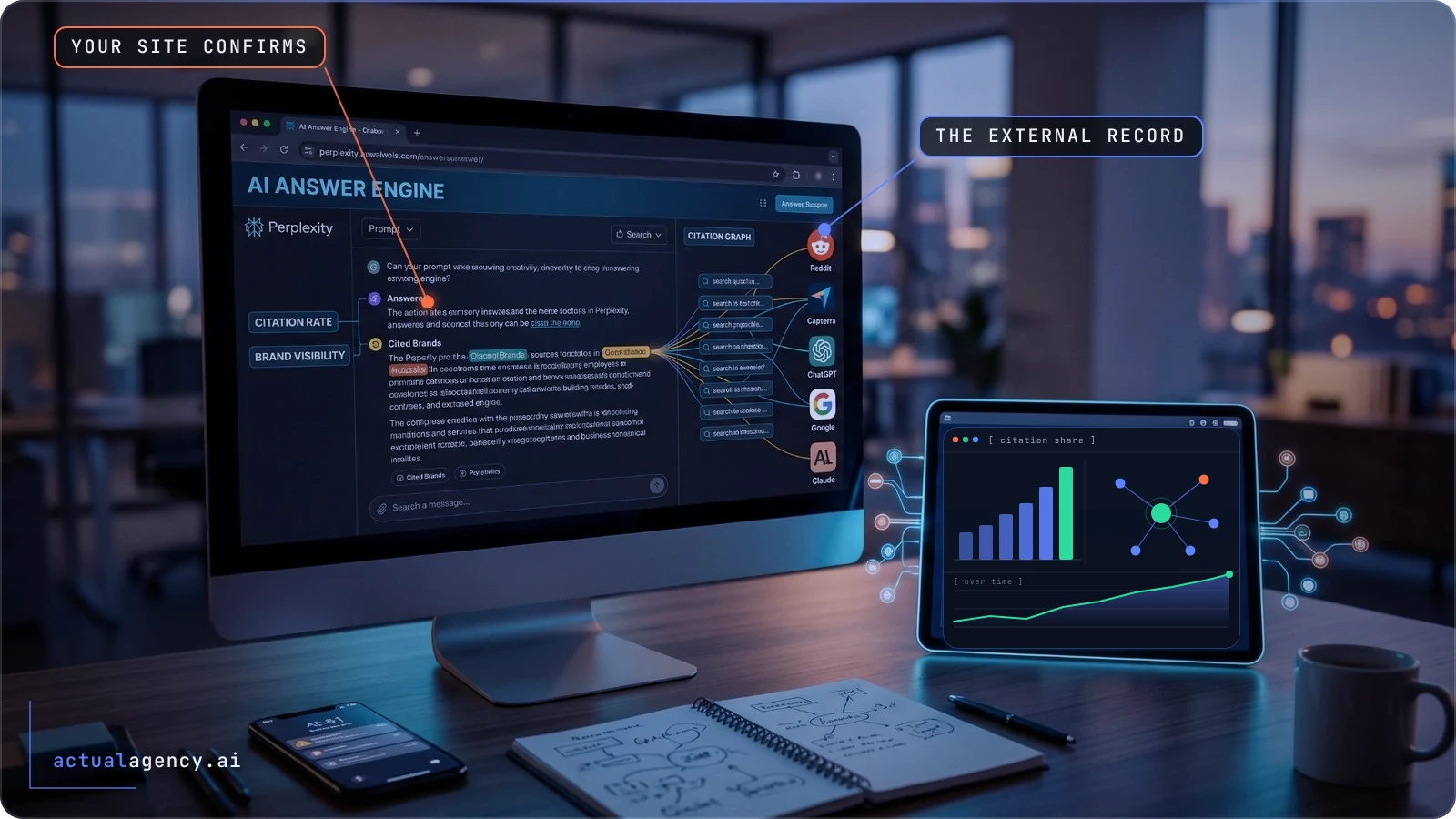
Ranking well in search no longer guarantees that your brand is in the AI answer. The question now is whether AI engines name and cite you at all. That is an absence problem before it is a ranking problem, and the distinction matters.
This is worth sitting with. The consideration set for most B2B purchases is now being assembled inside an AI answer before a buyer ever visits a website. GetIntel's October 2026 analysis of 469 B2B software searches, fetched as 935 result pages on desktop and mobile, found a Google AI Overview on 98.2% of them, sitting above the first ordinary result on 94.8%. It is a one-day snapshot of software-buying searches, not of Google overall. The shortlist is forming in the answer box, and a brand that is not named there is not on it.
The question is what actually drives citation. The answer is more tractable than most communications leaders expect, and it does not require a complete overhaul of your content strategy. It requires a prioritized sequence of specific actions, targeted at how each engine actually selects sources.
Here is that sequence.
Understand What Each Engine Is Actually Doing
Before optimizing for AI citations, it helps to understand that ChatGPT, Claude, and Perplexity are not running the same process. Treating them as interchangeable is one reason most optimization efforts underperform.
Rankeo's B2B SaaS citation benchmarks, published in May 2026 from 142 B2B SaaS sites, put numbers on some of the differences. Claude cites the most distinct brands per answer (5.1), against 3.8 for ChatGPT and 3.4 for Gemini. ChatGPT is the most concentrated engine, with a 24% top-brand share in B2B SaaS answers. Perplexity pulls roughly 24% of its B2B SaaS citations from Reddit. Rankeo sells tracking software, and its dataset is English-language and dominated by US and UK queries, so treat the figures as directional.
Rankeo's guidance for brands not yet in the top tier is to start with Claude and Perplexity, and for brands already named consistently to defend their ChatGPT and Gemini share. I think that is a reasonable starting point.
The Citation vs. Mention Distinction
One more thing to clarify before getting into tactics. AI engines do two different things: they name a brand in the prose of an answer, and they cite a source with a link. These are not the same signal, and they do not always occur together.
In my experience, the primary problem for many B2B brands is not persuading the model to like them. It is getting their content into the research pool in the first place.
Step 1: Build the Third-Party Record First
The single most important finding in the current citation research is this: in AirOps's analysis of 21,311 brand mentions across ChatGPT, Claude, and Perplexity, 85% of brand mentions came from external domains, and on top-of-funnel commercial queries a mention was 6.5 times more likely to come from third-party content than from the brand itself. AirOps is a vendor and the study dates from October 2025, so treat the numbers as directional.
Your own site matters, but it is not where the citation battle is won. The battle is won in the external record: earned media, analyst coverage, review platforms, community forums, and independent editorial.
What this means in practice:
Prioritize earned media placements in publications your buyers already read. A mention in a trade publication that AI engines index is worth more than a new page on your own site.
Get reviewed on G2, Capterra, and similar platforms. They anchor the third-party record that validates a mention.
Pursue inclusion in independently authored comparison roundups. Rankeo's regression analysis found that pages following the "X vs. Y" and "X alternatives" patterns are cited 3.7 times more on ChatGPT than feature pages. You want to appear in those comparisons, not just publish them yourself.
Develop a Reddit and community presence. Rankeo reports that Perplexity pulls roughly 24% of its B2B SaaS citations from Reddit. A brand that is discussed credibly in relevant subreddits and professional communities has a structural advantage on that engine.
The underlying logic is that AI engines are doing something similar to what a diligent analyst does before a vendor recommendation: they check whether other credible sources agree. A brand that exists only on its own website looks like a brand that has not yet earned external validation.
This is not a new problem. It is the same problem PR has always solved. The difference is that the audience is now partly machine. For the full playbook on building this layer, see The Third-Party Validation Playbook.
Step 2: Make Your Own Site Retrievable
Once the external record is in place, your own site becomes the confirmation layer: the place an engine checks after it has already found reasons to consider you. The problem is getting retrieved in the first place.
Retrieval is a function of content clarity, freshness, and structural signal. A few specific actions move the needle:
Write content that answers the questions buyers actually ask AI engines
AI engines search for answers to specific questions. A site full of product marketing copy does not answer questions. A site with clearly structured content that addresses "What does [your category] cost?", "How does [your approach] compare to [alternative]?", and "What problems does [your solution] solve for [specific role]?" gives the engine something to retrieve and cite.
In my experience, freshness matters. Pages that have not been touched in two years are less likely to enter the research pool, so keep the pages you want cited current and date them.
Publish substantive documentation
For Claude specifically, the depth of your documentation library appears to matter. Rankeo reports that brands with more than 100 documentation pages receive 2.3 times more Claude citations than brands with fewer than 50, and that going from 100 to 200 pages produces another 1.4x lift. Rankeo's figures come from a regression on its 142-site dataset and it does not say why the effect exists. A plausible reading is that Claude rewards material it can synthesize from, and that thin sites give it less to work with.
Structure content for extraction
Each major page or article should open with a direct, self-contained answer to the question it addresses. AI engines extract individual sections, not full documents. A section that requires reading three preceding paragraphs to make sense is a section that will not be cited. Write each section so it stands on its own. This is less about SEO mechanics and more about the basic clarity of your thinking on the page.
For a deeper look at how executive thought leadership fits into this structure, see Executive Thought Leadership for AI Search.
Step 3: Establish Your Brand as a Known Entity
There is a meaningful difference between a brand that AI engines have encountered across many sources and one that appears only occasionally. In my experience, that familiarity compounds: a brand with a broad, consistent presence is easier for a model to place in a category than one with a thin, inconsistent footprint.
Building entity recognition is a longer-term effort, but it has concrete components:
Consistent naming and categorization. Every external mention of your brand should use the same name, describe the same category, and convey the same core positioning. Inconsistency across sources creates ambiguity that models can resolve by deprioritizing the brand.
Wikipedia and structured data presence. For brands of sufficient scale, a Wikipedia entry provides a structured anchor that helps resolve entity ambiguity. For smaller brands, schema markup on your own site (Organization, Product, Person) performs a similar function.
Executive visibility. Named individuals associated with a brand extend its entity footprint. A CEO with published bylines, interview mentions, and a LinkedIn presence that references the company creates additional retrieval paths. This is one reason thought leadership has a practical citation function, not just a brand-building one.
The underlying mechanism here connects to what I call agentic awareness: the degree to which AI systems can reliably identify, interpret, and represent your brand when constructing an answer. A brand with a coherent, well-distributed information footprint is easier for a model to reason about confidently.
Step 4: Prioritize by Engine, Not by Generic Best Practice
Most AI citation advice treats the engines as a single target. They are not. Where Claude names the most distinct brands per answer and ChatGPT concentrates on a few, the effort that wins on one does not automatically win on the other.
This has real implications for where to concentrate effort. Early on, Claude and Perplexity are the more accessible engines on Rankeo's reading. Once you are named consistently, ChatGPT and Gemini are where you defend a position.
Concentration is worth taking seriously. Rankeo's ChatGPT top-brand share of 24% in B2B SaaS answers suggests citation is winner-concentrated, which means the cost of delay is not linear. Every month a competitor builds citation share in your category is a month of compounding advantage they accumulate.
The brands that will be hardest to displace in AI answers eighteen months from now are the ones building their citation infrastructure today.
Step 5: Measure What Is Actually Happening
The final step is the one most teams skip: establishing a baseline and tracking it.
You cannot improve what you are not measuring. And measuring AI citation is not the same as measuring search rankings. A brand can rank well in traditional search and still be largely absent from AI answers, so rankings tell you little about whether you are being named.
A basic measurement framework for AI citation visibility looks like this:
Define your prompt set. Identify 20 to 50 questions your buyers are likely to ask AI engines at each stage of the purchase process. These should reflect real language, not marketing language.
Run those prompts across ChatGPT, Claude, and Perplexity weekly. Track whether your brand is named, whether your site is cited, and what context surrounds the mention.
Track third-party source coverage. Monitor which publications, review platforms, and community sources the engines are pulling from when they discuss your category. These are the sources you need to be in.
Compare against the category. Citation share is relative. Knowing you appear in 12% of relevant answers means little without knowing your nearest competitor appears in 31%.
The measurement cadence matters because AI citations are not static. In my experience they drift within weeks, so a campaign that earns citations in October may see those citations erode by December without continued investment in the underlying signals.
Treating AI citation as a one-time project rather than an ongoing program is the most common mistake in this space right now. The brands getting this right are the ones that have built it into their regular communications rhythm.
The Sequence in Summary
The five steps above are ordered by priority, not by ease. The third-party record comes first because it has the largest effect on citation probability and because it takes the longest to build. Your own site content comes second because it is the confirmation layer that converts retrieval into citation. Entity recognition comes third because it is the compounding factor that makes everything else more effective over time.
The core insight: AI engines do not discover brands. They confirm brands they already have reason to believe are relevant. The work of AI citation optimization is largely the work of giving them more reasons, from more credible sources, more consistently.
Most communications teams are spending the majority of their time on the layer that matters least (their own site) and the least time on the layer that matters most (the external record). Reversing that ratio is where the citation gains are.
The window to build this infrastructure before your category concentrates is narrowing. The concentration in ChatGPT answers suggests the same pattern may be forming here. The brands that move now will be significantly harder to displace than those that wait for the pattern to become obvious.
Frequently Asked Questions
- How do I get my brand cited more often in AI answers?
- Build the third-party record first, because most brand mentions in AI answers come from pages the brand does not own. Then make your own site easy to retrieve, establish your brand as a consistent entity, prioritize by engine, and measure citations on a fixed prompt set every week.
- Why is my brand missing from ChatGPT, Claude, and Perplexity answers?
- Usually because the sources those engines draw on, such as earned media, review platforms, and community discussion, do not mention you consistently. Ranking well in traditional search does not change that, because AI engines weigh what third parties say about a brand more than what the brand says about itself.
- Do ChatGPT, Claude, and Perplexity cite brands the same way?
- No. They differ in how many brands they name per answer and in which sources they lean on, for example Perplexity's heavy use of Reddit in B2B software answers. Treat any single engine ranking as directional and audit each engine separately.
- How often should I measure AI citations?
- Weekly is a practical cadence. In my experience citations drift, so a gain earned in one month can erode without continued work on the underlying signals.