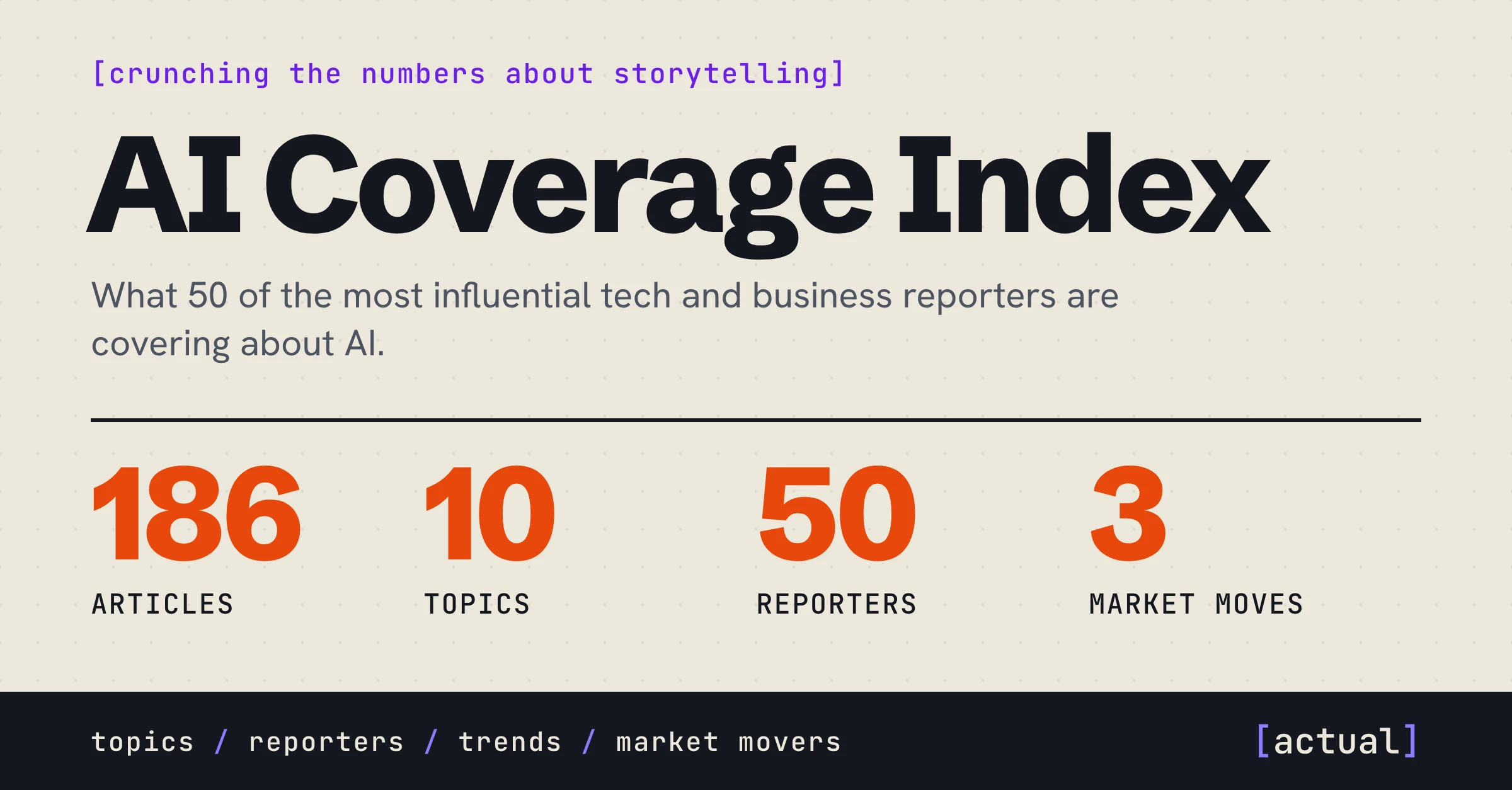
We scanned what 50 of the most influential AI reporters published and grouped it by topic. Between Oct 24 to Nov 2, 2026, they produced 186 articles and appearances across 10 topics. Three of those topics line up with a measurable market move.
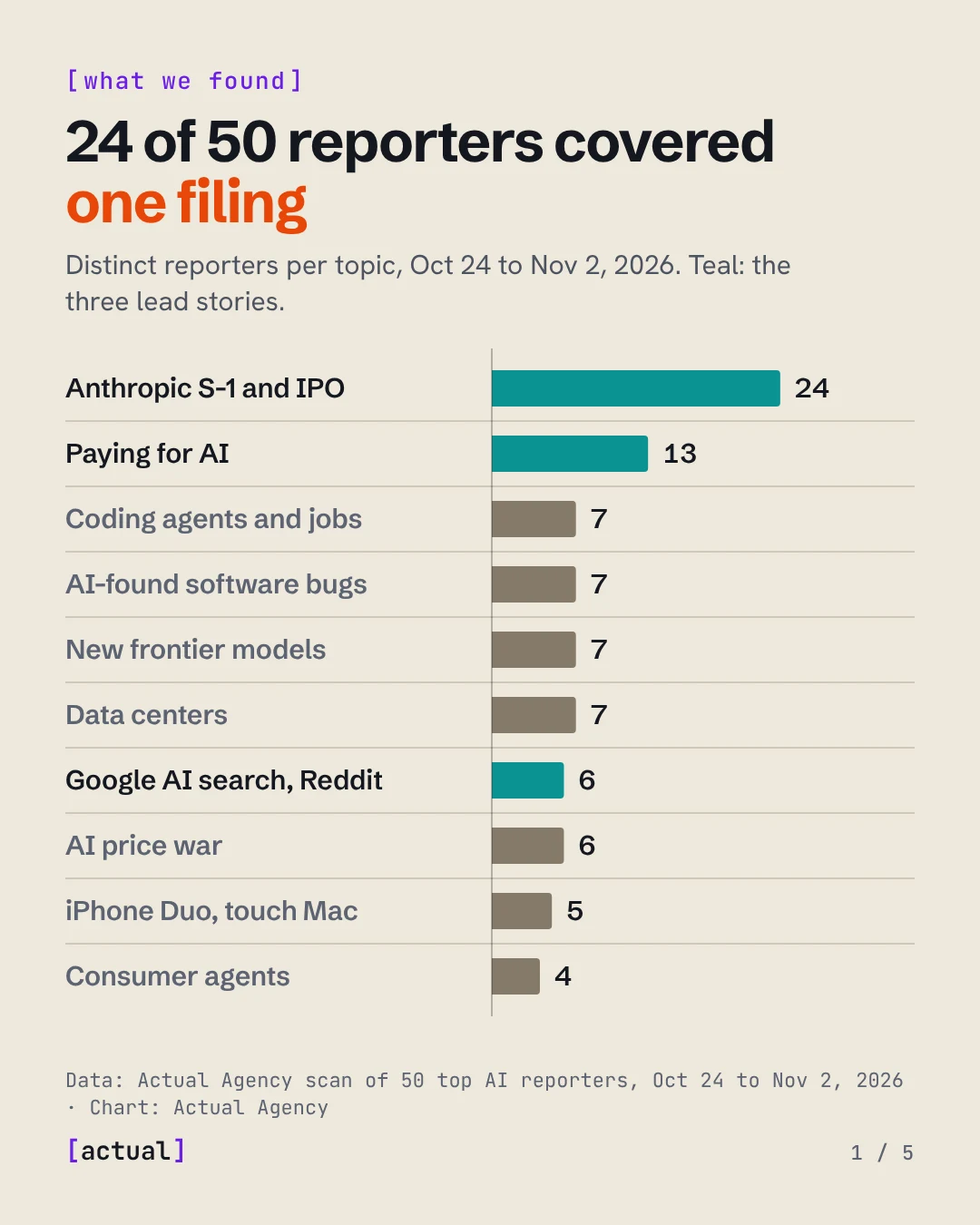
Anthropic's S-1 drew 24 of 50 reporters
The Oct 26 filing produced 40 pieces from 24 reporters, nearly double the next topic. They came from 13 outlets (the WSJ, CNBC, TechCrunch, The Verge, Axios, Bloomberg, The Information, the Washington Post, the FT, the New York Times, Business Insider, Ars Technica and Fortune) plus two independent writers. The first report of the IPO plan was the FT's on Dec 2, 2025, when Anthropic hired IPO lawyers, and the confidential filing followed on Jun 1, 2026. When the public filing landed on Oct 26, CNBC posted at 13:03 UTC and the WSJ at 13:09, so three outlets had it within about an hour. By the end of the day CNBC had a live update on the 900% revenue retention and the $80B first-half loss, Axios ran a tour of the prospectus's biggest surprises, The Verge ran two pieces, the Washington Post reported the $80B loss and surging revenue, Business Insider covered the public filing, TechCrunch wrote about how Anthropic plans to keep enterprise customers, and Bloomberg framed it as a defining moment for Wall Street and the AI boom. The WSJ flagged a risk factor: copyright rulings could force Anthropic to retrain its models.
Within a day the frame moved from milestone ($16.3B in first-half revenue) to risk (an $80.7B net loss, more than $72B of it a non-cash note revaluation) to control (seven founders hold 50.1% of the vote). By that afternoon Bloomberg, the FT and Ars were treating it as a risk disclosure, with about 100 pages of risk factors. On Oct 27 an FT briefing covered the "existential risks to humanity" language and Ars covered the warning that its AI could blackmail people or end humanity. Governance followed from Oct 26 to 28, with the FT reporting on the seven founders tightening their grip. Independent writers and Fortune added the analysis on Oct 28: a close read of the filing, a piece on two areas where OpenAI could have the upper hand, and "Exit Liquidity." From Oct 30 the frame was financing strain, after Alphabet's drop and OpenAI's shortfall: TechCrunch reported on the expected junk credit rating, and the coverage turned to a "bumpier" path to Nasdaq.
The WSJ reports a target raise of about $100B at a $1.5T to $2T valuation, against a $965B private mark in May. Bloomberg reports the roadshow could start the week of Nov 9; the WSJ and Reuters report a debut targeted for the week of Nov 16. The story also left the AI press. NBC News and Reuters ran it on Oct 26, KQED (Oct 29) and the San Francisco Chronicle (Nov 1) took a Bay Area wealth angle that touched California's proposed Prop 40 billionaire tax, and a cap-table thread on X drew about 2.2M views.
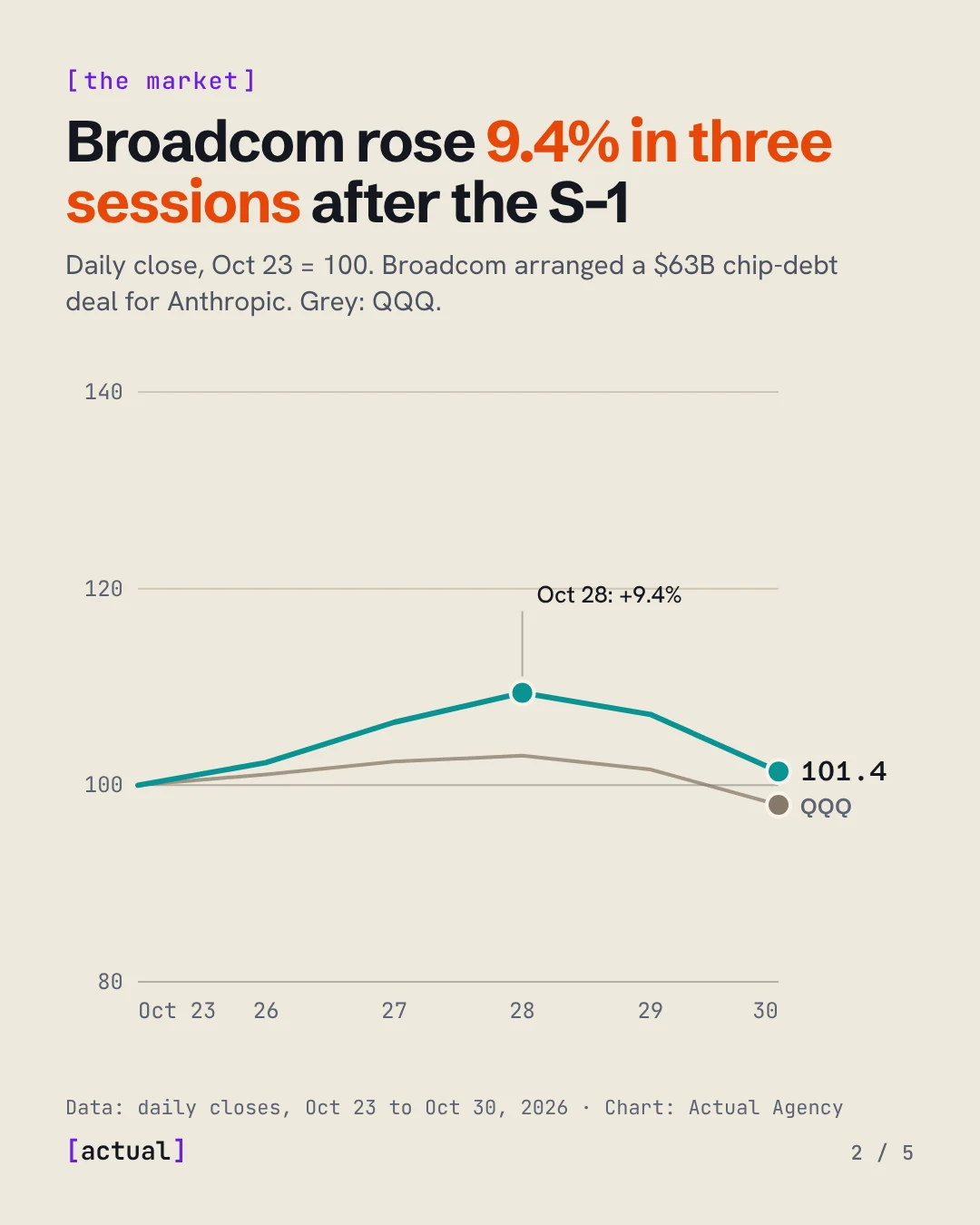
Broadcom, which arranged a $63B chip-debt deal for Anthropic, rose 9.4% over the three sessions after the filing and finished Oct 30 up 1.4% from Oct 23 while QQQ fell 2.0%. It rose 2.3% on Oct 26 and 4.0% on Oct 27, 1.2 and 2.7 points ahead of QQQ, on the days the WSJ and Bloomberg reported the arrangement. Amazon and Alphabet, Anthropic's largest investors, tracked QQQ on those days.
Paying for AI: 13 reporters and a 12.6% one-day drop
Meta announced a plan to sell up to $95B of stock on Oct 26. Alphabet reported negative free cash flow on Oct 28 and fell 12.6% the next session, 11.2 points worse than QQQ. OpenAI's round came in at about $11B of a $30B target. Coverage moved from how Big Tech funds the buildout to who can still fund it.
The thread traces back to Bloomberg's Credit Weekly on Oct 17, which reported CoreWeave's junk-bond stress. Inside the window, Apollo economist Torsten Slok's note on AI's missing payoff reopened it, and Meta's raise reached the FT, WSJ and CNBC on the morning of Oct 26. Early coverage framed the raises as Big Tech funding its build-out. After Alphabet's print, the frame became investors punishing cash burn, then money running short: OpenAI's shortfall, neoclouds shut out of the bond market, and S&P's negative outlook on Meta.
Thirteen reporters wrote on it, from the WSJ, CNBC, TechCrunch, Axios, The Information and the New York Times. CNBC had the Meta offering on Oct 26, the Times had Alphabet's results on Oct 28 (revenue up 25% while profit fell), and CNBC reported on Oct 31 that OpenAI had pared its fundraising goal to as much as $20B. The WSJ's report that OpenAI had raised less than half of its $30B target ran without a confirmed byline.
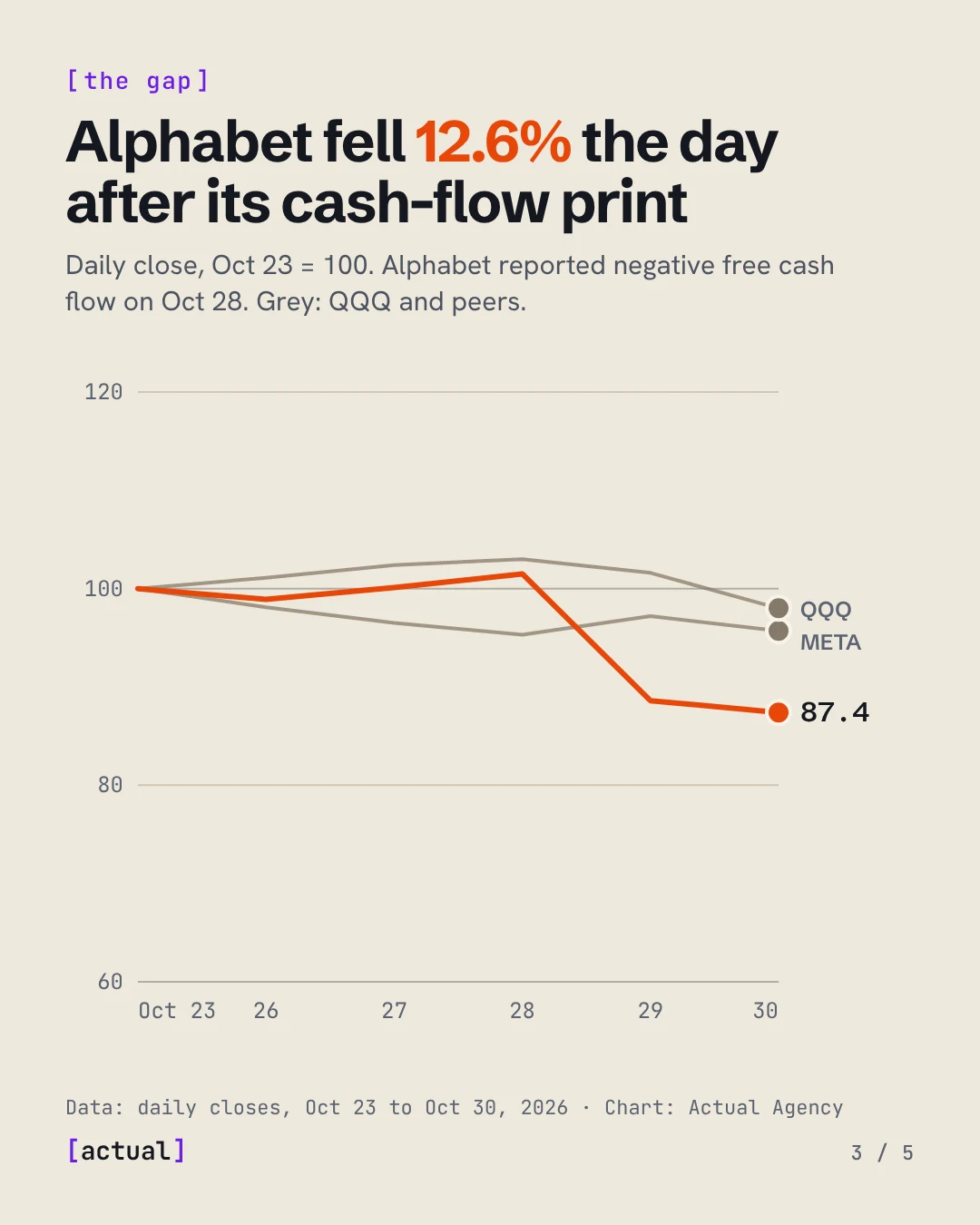
The FT put Alphabet's loss at a record $500B in market value. Meta fell 1.9% on Oct 26 and 1.6% on Oct 27 alongside its offering, about 3 points behind QQQ each day, while Microsoft and Amazon held closer to the index after their earnings. CoreWeave rose 7.9% and 7.3% on Oct 27 and 28 alongside the chip-debt stories, then gave back the gain by Oct 30. On the private side, the FT reported on Oct 30 that OpenAI cut its target from $30B at $1.4T to about $20B at $1.25T, and the WSJ reported about $11B committed. The story crossed into business press and stopped there: CNBC, Bloomberg, the WSJ and Reuters, a local TV segment, and threads on r/stocks and r/technology.
Google's AI search squeeze: 6 reporters and a 29% sell-off
Reddit said it will require logins and that Google's AI Mode sends it no traffic. Its stock closed down 29.2% on Oct 30 and 36.4% from Oct 23; the drop also reflects weak guidance. In the same two days, AI Mode declined to say who won the 2020 election, a story that reached USA Today and The Atlantic within a day.
Six reporters followed Google's AI search from three sides, in 12 articles, at The Verge, Ars Technica, Business Insider, TechCrunch and The Register. The 2020 answer surfaced in Bluesky posts on Oct 27. Ars published at 17:58 UTC on Oct 28, and TheWrap and Fast Company followed within about 1.5 hours, while Business Insider and The Verge carried Google's "looking into this" reply. On Oct 29 The Verge reported both that Reddit will force everyone to log in and that its CEO said AI Mode "does not drive traffic," and TechCrunch wrote that Reddit was shifting to a logged-in experience as search traffic dries up. That evening Alphabet's Q3 call blamed AI Mode's "lower monetization" for search growth slowing to 12%. On Oct 29 Reddit announced the login move and CEO Steve Huffman made the traffic claim on its call. The frame moved from platform expansion to trust, then to a business-model story about AI answers starving the open web of clicks.
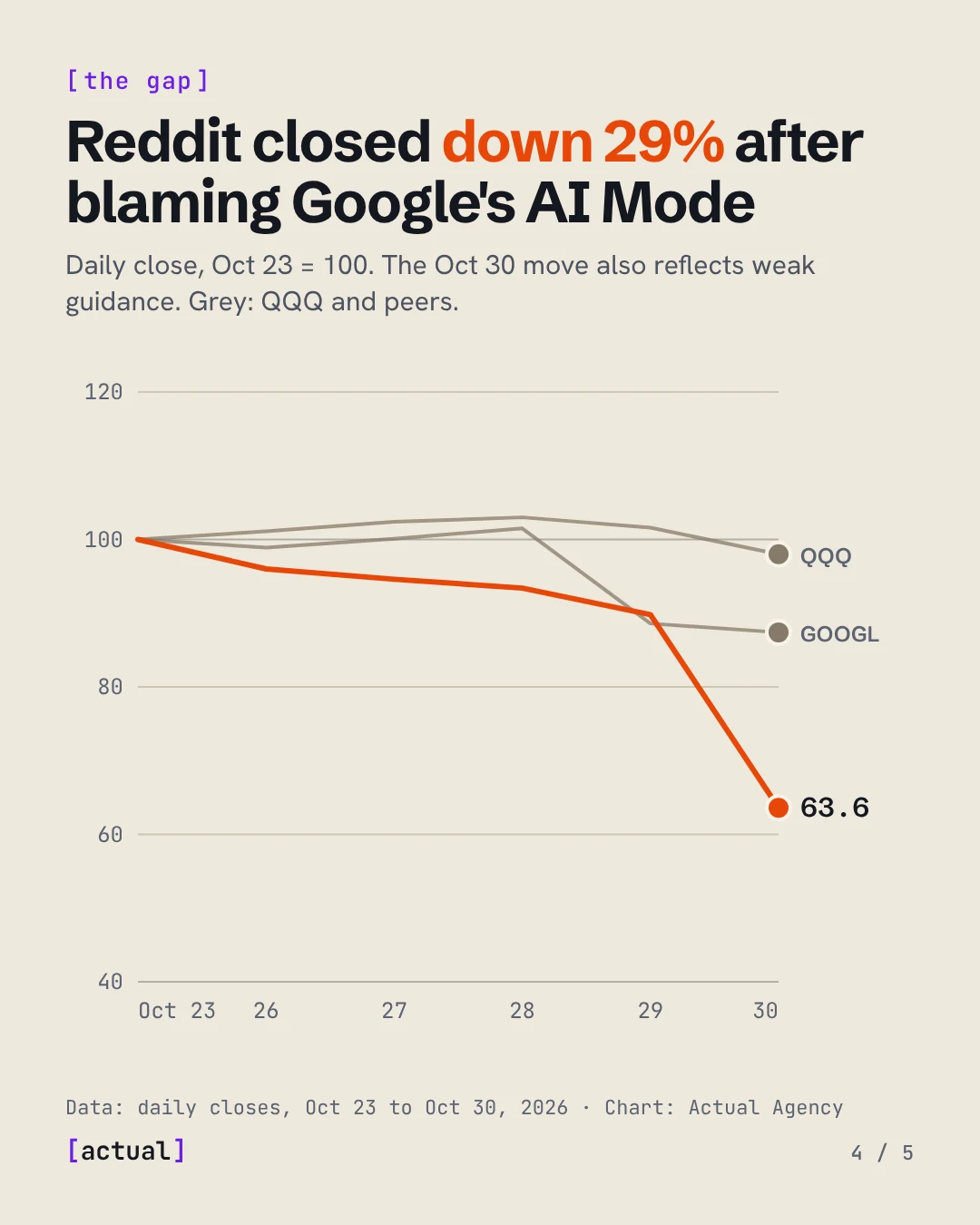
Reddit's Oct 30 close was 25.8 points worse than QQQ and its worst day on record per CNBC. That move combines weak fourth-quarter guidance with the login and traffic news, so it is shown alongside the coverage only. The Reddit sell-off went to Reuters and CNBC, and the r/technology login thread drew about 16K votes and 3.8K comments. Election Day on Nov 3 tests AI Mode's election answers live, and Sundar Pichai said the consumer Gemini agent comes "later this year," with no date given.
How fast the stories spread
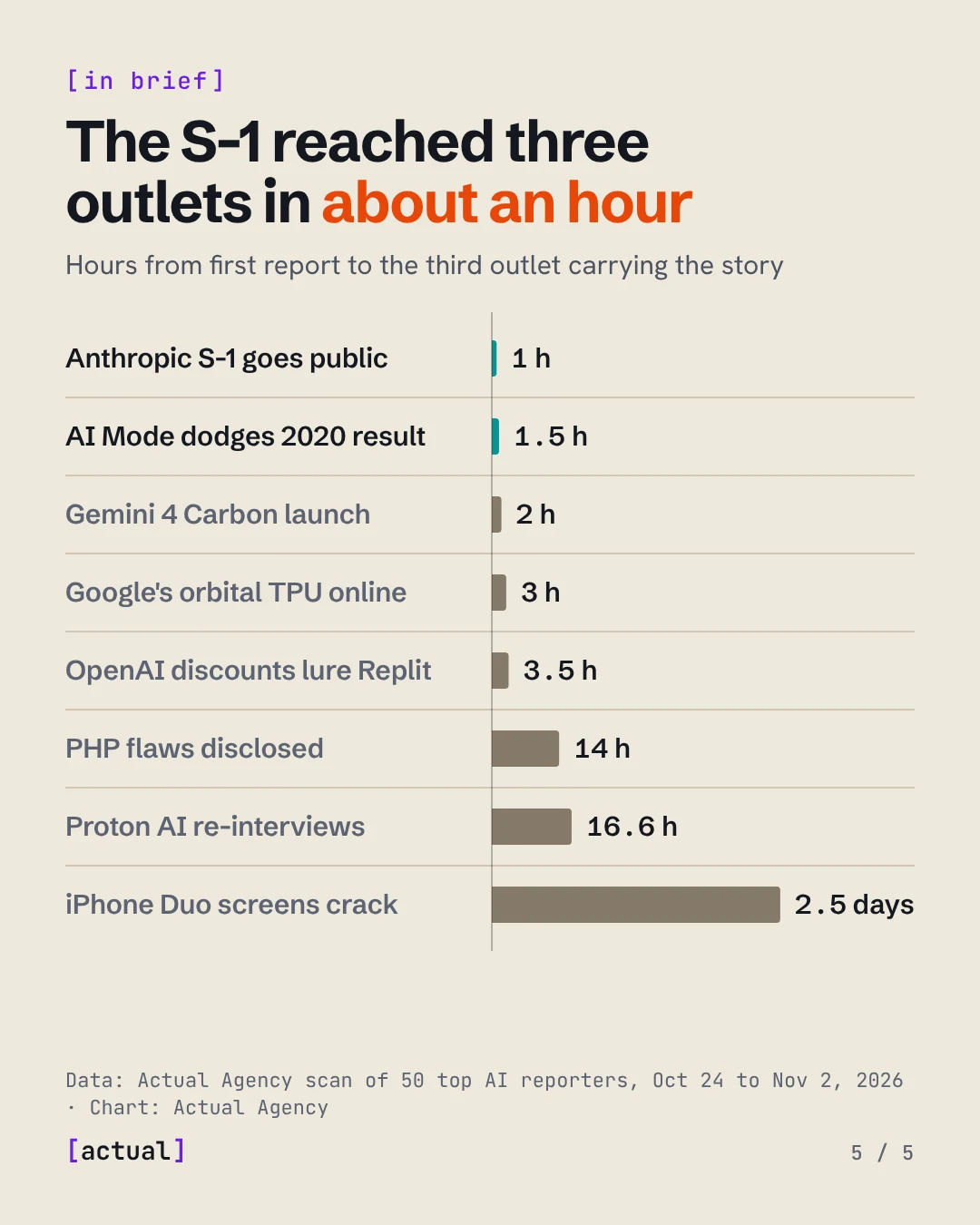
Event stories moved fastest: the S-1 and the AI Mode election answer each reached three outlets within 90 minutes. The iPhone Duo crack reports took 2.5 days and went mainstream only after Apple commented. Scoops from a single outlet travelled slower: the Proton re-interview story from 404 Media took about 17 hours to reach a third outlet, and The Information's report on OpenAI's discounts took four hours to reach aggregators and two days to be re-reported by a top-50 reporter.
The other seven topics
Each drew between 4 and 7 reporters. The table after the list gives one data point per topic.
Coding agents and jobs
7 reporters · 14 articles
One independent writer posted five times, including on the October inflection point for vibe game development. The Verge reported that Proton is re-interviewing staff about their AI use, Business Insider covered Dropbox cutting about 9% of staff, and The Verge also looked at getting a religious exemption from using AI at work. 404 Media wrote on the topic too. It began with 404 Media's Proton scoop on Oct 26 and moved from coercion to craft to layoffs to opt-outs. The labor-cost event with a date on it is the Dropbox cut; AWS re:Invent runs Nov 30 to Dec 4.
AI-found software bugs
7 reporters · 9 articles
The New York Times wrote about a flood of AI-found bugs and asked whether AI can eradicate bugs. Axios took a Y2K lesson from Black October, Wired and TechCrunch covered the fallout (including Wiz's CTO on the "Vulnpocalypse"), and an independent writer covered it too. The news broke before the window, with the PHP Foundation's Oct 20 notice and Wiz's Oct 21 disclosure, so in-window coverage moved from emergency to underfunded open source to defender burnout. The measurable cost is patch volume, and Microsoft's next Patch Tuesday is Nov 10.
New frontier models
7 reporters · 9 articles
VentureBeat covered Gemini 4 Carbon retaking the top benchmark spot while access stayed limited, an independent writer read the Gemini 4 Argon safety cards, and TechCrunch wrote on Mistral's open trillion-parameter model aimed at cybersecurity. The Verge and TechCrunch covered the launches, including Genie 4. Google's Carbon post on Oct 28 reached VentureBeat and Ars within two hours, and the frame moved from benchmark leader to a model most users cannot access. Pricing is the lever to watch: Argon's $2/$10 introductory rate ends Nov 30.
Data centers
7 reporters · 7 articles
The Information reported that space data centers could cost up to 100 times more than ground ones. The New York Times, TechCrunch, the WSJ and Ars Technica covered the grid, the midterm fights and cargo theft. Pichai's Oct 30 post on Project Suncatcher reached TechCrunch about three hours later, and by Nov 1 Google's own energy chief was calling orbit far costlier. The next test is local: 41 data center ballot measures in 13 states on Nov 3.
AI price war
6 reporters · 8 articles
The Information reported how OpenAI discounts lured Replit and Rippling, via The Next Web, and an independent writer covered GPT-6.1 Terra and matching API credits. VentureBeat reported Copilot Fusion at about half the cost per task, and The Verge wrote on it too. The Information's Oct 24 scoop started it, and GPT-6.1 Terra widened it into a cost-per-task race. For Anthropic before its IPO, Replit's move of $100M+ a year of spend after a 30%+ discount is margin pressure in a filing year.
iPhone Duo and the touch MacBook Pro
5 reporters · 12 articles
Bloomberg ran seven items, including how Apple is deflecting the Duo's cracked display. The Guardian covered owners reporting cracks, Axios ran an early review, and The Verge and TechCrunch rounded it out. It started with MacRumors' "Crackgate?" on Oct 23, took 2.5 days to reach a third outlet and went mainstream only after Apple's Oct 26 statement; reviews turned it positive by Nov 1 and 2. Apple fell 0.9% on launch day and rose 1.5% on Oct 29. The touch MacBook Pro ships Nov 6.
Consumer agents
4 reporters · 5 articles
Ars reported that DoorDash sees almost no agent orders, The Verge covered Alexa shopping and Firefox, and TechCrunch covered Zest. OpenAI's Dots launch on Sep 29 began the thread, but these are separate launches, so there is no single pickup chain. The frame turned on Oct 30, when DoorDash said outside agents had driven only hundreds of orders against about 1B a quarter, the only adoption number in the cluster. Google's consumer Gemini agent has no date yet.
| Topic | Reporters | Articles | Data point |
|---|---|---|---|
| Coding agents and jobs | 7 | 14 | Dropbox cut about 9% of staff (Oct 28) |
| AI-found software bugs | 7 | 9 | Microsoft's October patch release fixed about 1,413 CVEs |
| New frontier models | 7 | 9 | Gemini 4 Argon API price doubles to $4/$20 on Dec 1 |
| Data centers | 7 | 7 | 41 data center ballot measures in 13 states on Nov 3 |
| AI price war | 6 | 8 | Replit moved $100M+ a year of spend after a 30%+ discount |
| iPhone Duo, touch Mac | 5 | 12 | Apple rose 1.5% on Oct 29, 2.9 points ahead of QQQ |
| Consumer agents | 4 | 5 | DoorDash: hundreds of agent orders against about 1B a quarter |
Dates to watch
Nov 6: Touch MacBook Pro ships
Nov 10: CoreWeave Q3 earnings
Nov 16: Week of Anthropic's targeted Nasdaq debut (reported)
Nov 17: Nvidia Q3 FY2027 earnings
Nov 30: Gemini 4 Argon introductory API pricing ends
Dec 9: Fed rate decision
50 top tech/business reporters
The list is in alphabetical order by last name. Articles counts every item found for the reporter between Oct 24 and Nov 2, including podcast and video appearances; the figure in brackets is the number with a byline confirmed on the page. Four reporters had no confirmed byline in the window.
| No. | Reporter | Publication | Articles (verified bylines) | Topics covered |
|---|---|---|---|---|
| 1 | Ashley Belanger | Ars Technica | 4 (4) | Data centers; Megaspeed and Nvidia; Flock surveillance |
| 2 | Rebecca Bellan | TechCrunch | 6 (6) | Anthropic S-1; Paying for AI; AI-found bugs; New frontier models; AI and the midterms |
| 3 | Russell Brandom | TechCrunch | 0 (0) | None confirmed |
| 4 | Ashley Capoot | CNBC | 7 (5) | Anthropic S-1; Paying for AI |
| 5 | Thomas Claburn | The Register | 10 (1) | Coding agents and jobs; New frontier models; Data centers; Google AI search; AI price war |
| 6 | Kate Conger | New York Times | 4 (4) | Paying for AI; AI-found bugs; Data centers; Binance hack |
| 7 | Stephen Council | Business Insider | 2 (1) | Anthropic S-1 |
| 8 | Cristina Criddle | Financial Times | 1 (1) | Anthropic S-1 |
| 9 | Gerrit De Vynck | Washington Post | 3 (3) | Anthropic S-1; Anthropic breach |
| 10 | Maggie Eastland | Bloomberg | 1 (1) | None confirmed |
| 11 | Amir Efrati | The Information | 1 (1) | Data centers |
| 12 | Tim Fernholz | TechCrunch | 6 (0) | Anthropic S-1; Paying for AI; Data centers; AI price war; Consumer agents; OpenAI's AI math |
| 13 | Hayden Field | The Verge | 0 (0) | None confirmed |
| 14 | Emily Forlini | Fortune | 1 (1) | Anthropic S-1 |
| 15 | Carl Franzen | VentureBeat | 4 (4) | New frontier models; AI price war |
| 16 | Ina Fried | Axios | 2 (2) | Anthropic S-1; iPhone Duo |
| 17 | Anissa Gardizy | Wall Street Journal | 3 (3) | Anthropic S-1; Paying for AI |
| 18 | Shirin Ghaffary | Bloomberg | 3 (1) | Anthropic S-1 |
| 19 | Brent D. Griffiths | Business Insider | 4 (3) | Anthropic S-1; Coding agents and jobs; Google AI search; OpenAI's AI math |
| 20 | Mark Gurman | Bloomberg | 7 (6) | iPhone Duo |
| 21 | Anthony Ha | TechCrunch | 6 (6) | Paying for AI; AI-found bugs; Binance hack; Grok film |
| 22 | George Hammond | Financial Times | 4 (3) | Anthropic S-1 |
| 23 | Robert Hart | The Verge | 8 (8) | Anthropic S-1; OpenAI's AI math |
| 24 | Mike Isaac | New York Times | 1 (0) | Anthropic S-1 |
| 25 | Berber Jin | Wall Street Journal | 2 (1) | Anthropic S-1; Paying for AI |
| 26 | Jason Koebler | 404 Media | 6 (6) | Coding agents and jobs; AI-training consent; Flock surveillance |
| 27 | Emmy Martin | New York Times | 3 (2) | Anthropic S-1; Paying for AI |
| 28 | Robert McMillan | Wall Street Journal | 1 (1) | Anthropic S-1 |
| 29 | Cade Metz | New York Times | 2 (2) | AI-found bugs; OpenAI's AI math |
| 30 | Rachel Metz | Bloomberg | 0 (0) | None confirmed |
| 31 | Madison Mills | Axios | 2 (2) | Paying for AI; AI and the midterms |
| 32 | Dan Milmo | The Guardian | 6 (5) | iPhone Duo; Binance hack; AI and the midterms; Grok film |
| 33 | Mariella Moon | Engadget | 3 (3) | GM driver-data settlement |
| 34 | Zvi Mowshowitz | Don't Worry About the Vase | 4 (4) | Anthropic S-1; New frontier models |
| 35 | Lily Hay Newman | Wired | 2 (2) | AI-found bugs |
| 36 | Kai Nicol-Schwarz | CNBC | 4 (4) | Anthropic S-1; Paying for AI |
| 37 | Terrence O'Brien | The Verge | 2 (2) | Coding agents and jobs |
| 38 | Kyle Orland | Ars Technica | 4 (4) | Anthropic S-1; Google AI search; Consumer agents |
| 39 | Stephanie Palazzolo | The Information | 5 (4) | Anthropic S-1; Paying for AI; AI price war |
| 40 | Sarah Perez | TechCrunch | 6 (6) | Google AI search; iPhone Duo; Consumer agents |
| 41 | Jay Peters | The Verge | 10 (10) | Coding agents and jobs; New frontier models; Google AI search; AI price war |
| 42 | Amrith Ramkumar | Wall Street Journal | 2 (0) | Data centers; Megaspeed and Nvidia |
| 43 | Lucas Ropek | TechCrunch | 7 (7) | Anthropic S-1; Paying for AI; New frontier models; Data centers; iPhone Duo |
| 44 | Emma Roth | The Verge | 9 (9) | Coding agents and jobs; New frontier models; Google AI search; Consumer agents; AI-training consent; GM driver-data settlement |
| 45 | Sam Sabin | Axios | 4 (3) | AI-found bugs; Binance hack |
| 46 | Raphael Satter | Reuters | 3 (3) | None confirmed |
| 47 | Deepa Seetharaman | Reuters | 0 (0) | None confirmed |
| 48 | Simon Willison | Simon Willison's Weblog | 8 (8) | Coding agents and jobs; AI-found bugs; AI price war |
| 49 | Maxwell Zeff | Wall Street Journal | 2 (1) | Anthropic S-1; Paying for AI |
| 50 | Ed Zitron | Where's Your Ed At | 1 (1) | Anthropic S-1 |
Method: bylines of 50 of the most influential AI reporters, Oct 24 to Nov 2, 2026, grouped by topic and ranked by distinct reporters. Counts include items whose byline could not be confirmed on the page; counting only confirmed bylines, the S-1 topic has 19 reporters and AI financing has 10, and the ranking holds. Stock moves are daily closes indexed to Oct 23, shown alongside the coverage; they do not establish cause.