Your B2B website probably ranks in Google. It may even have a solid backlink profile, a fast load time, and content your team spent months refining. None of that guarantees you appear when a buyer asks an AI system who solves your exact problem.
The evidence for that gap is unusually direct. Semrush found that roughly 90% of the pages ChatGPT cites rank position 21 or worse in Google, if they rank at all (compiled here). Ranking and being cited are close to unrelated problems.
That gap is no longer theoretical. A 2026 benchmark by Digipuush found that 78% of B2B websites score Weak or Very Weak on AI search readiness, with an average score of just 37.9 out of 100. A separate 2X survey found that 96% of B2B companies are effectively invisible in AI-driven discovery. And only 3% of audited sites meet full readiness criteria.
The business case for fixing this is stark: Semrush's 2026 measurement puts AI-referred conversion at roughly 4.4 times the rate of organic traffic (compiled here), a multiplier taken across many properties rather than one. Being absent from AI-generated answers is not a vanity metric problem. It is a revenue problem.
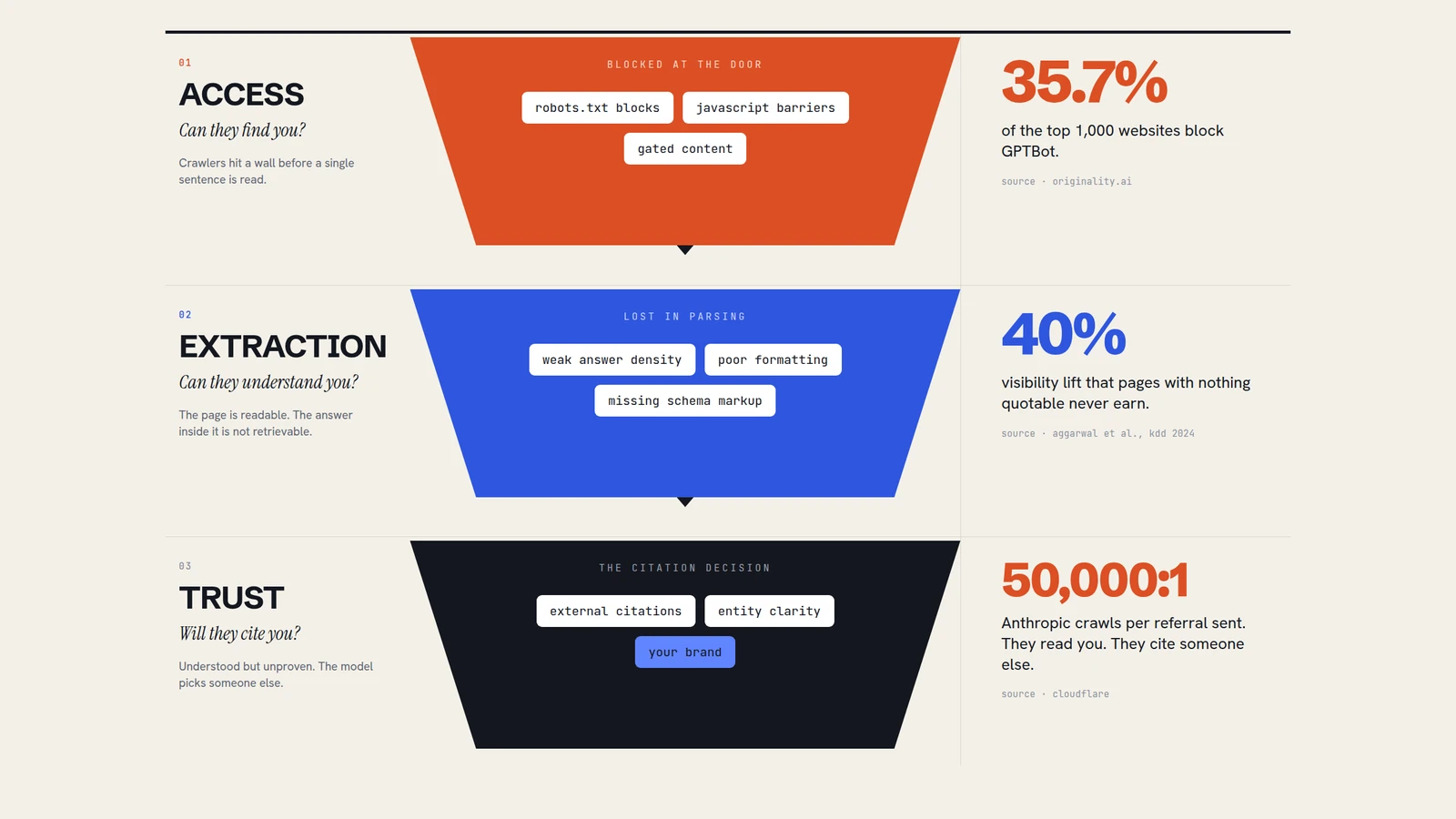
The good news is that AI search failure is not random. It follows a predictable pattern across three distinct layers: access, extraction, and trust. Most B2B brands are failing at all three simultaneously, and they do not know it because their analytics dashboards were never built to measure it. Only 9% of companies can currently segment AI-driven traffic from other sources.
This article breaks down each failure layer, what causes it, and what brands need to prioritize to move from invisible to cited.
The Measurement Problem Comes First
Before diagnosing failure modes, it is worth understanding why so few brands have caught this problem already. The answer is instrumentation. Traditional analytics tools were built around Google Search, paid media, and referral traffic. AI engines like ChatGPT, Perplexity, and Google's AI Overviews do not show up cleanly in those reports.
The result: most marketing teams are operating blind. They see stable or growing organic traffic and assume their content strategy is working. What they cannot see is the parallel buyer journey happening entirely inside AI interfaces, where their brand may never appear.
Key insight: A brand can rank on page one of Google and still be functionally invisible to the AI systems its buyers now use to shortlist vendors. These are two different visibility problems requiring two different solutions.
Fixing the measurement gap is step zero. Without it, brands cannot prioritize remediation, track progress, or make the internal case for investment. Once visibility into AI-referred traffic exists, the three structural failure layers become actionable.
Failure Layer One: Access
The most basic requirement for AI visibility is that AI systems can actually reach and read your content. A surprising number of B2B websites fail at this foundational level before any question of content quality even enters the picture.
Deliberate blocking is real but narrower than the headline numbers suggest. Ahrefs measured GPTBot disallowed on 5.89% of 140 million sites, while Originality.AI found 35.7% of the top 1,000 sites blocking it (both compiled here). The web at large lets AI crawlers in. Large publishers do not.
For most B2B companies the access failure is therefore not a policy decision at all. It is robots.txt rules written for traditional search bots, bot-blocking middleware that cannot tell an answer engine from a scraper, JavaScript-heavy architectures that render content client-side, and expertise locked behind forms.
The traffic those crawlers represent is no longer marginal. Cloudflare put AI crawlers at 20.3% of verified bot requests in May 2026 (compiled here). For most B2B sites the machines are already getting in. That is what makes the next two layers the expensive ones.
Common Access Failures
- Blocked or misconfigured crawlers: Rules in robots.txt that explicitly or inadvertently disallow AI crawlers like GPTBot, ClaudeBot, and PerplexityBot
- Client-side rendering: Pages that load content via JavaScript after the initial HTML response, which many AI crawlers cannot process
- Missing /llms.txt: A lightweight but increasingly expected signal file that tells AI systems what your site contains and how to navigate it
- Paywalled or gated content: Valuable expertise locked behind forms that AI systems cannot pass through
The access layer is the easiest to audit and the fastest to fix. A technical review of crawler permissions, rendering behavior, and site architecture can identify and resolve most of these issues in days, not months. The tragedy is that many B2B brands invest heavily in content that AI systems are structurally prevented from ever reading.
Failure Layer Two: Extraction
Passing the access test means AI systems can crawl your site. It does not mean they can use what they find. Extraction is the ability of an AI system to identify, isolate, and accurately quote or paraphrase your content in a generated answer. This is where the majority of B2B content strategy falls apart.
The architecture problem has shifted. As one industry expert put it, the question is no longer "do we have schema?" but "can AI reliably extract, verify, and cite our offering?" Those are fundamentally different standards, and most B2B content was written to satisfy the first one.
What Extraction Failure Looks Like
AI systems prefer content that is modular, attributable, and easy to quote or paraphrase. Long-form prose written for human readers, organized around narrative flow rather than discrete answers, tends to perform poorly in extraction. The specific failure modes include:
- Weak answer density: Content that discusses a topic without directly stating a clear, citable answer to the question a buyer would ask
- Missing FAQ coverage: Structured Q&A that maps directly to buyer queries is one of the highest-performing content formats for AI citation, and most B2B sites have little to none
- Poor structured formatting: Walls of prose with no headings, no lists, and no clear hierarchy give AI systems no reliable extraction points
- Missing or incomplete schema markup: Without machine-readable signals about what a page means, an AI system has to infer it from prose, and it infers badly
The Writing Standard Has Changed
The practical implication is that B2B content needs to be rewritten to a different standard, and the size of the gap has been measured. In GEO: Generative Engine Optimization, presented at KDD 2024, Aggarwal and colleagues found that adding quotations, statistics and citations raised visibility in generative engine responses by up to 40%. Most B2B service and solution pages contain none of the three. They assert rather than quote, describe rather than quantify, and cite nobody. Every answer assembled without them is a citation those pages were never in the running for.
Rewriting to that standard does not mean dumbing content down. It means structuring it so the most important claim in any section can be lifted cleanly, without surrounding context, and still make sense.
A useful test: take any paragraph from your most important service or solution page and ask whether it directly answers a question a buyer would type into ChatGPT or Perplexity. If it reads like positioning copy rather than an answer, it will not be extracted.
Failure Layer Three: Trust
The third layer is the most strategic and the hardest to fix quickly. Even when AI systems can access and extract your content, they may still choose a competitor. That decision comes down to trust signals, the signals AI systems use to evaluate whether a source is authoritative enough to cite.
The scale of that filtering is measurable, and it is brutal. Cloudflare tracked how often each AI company crawls the web against how often it sends a visitor back. Anthropic crawled roughly 50,000 pages for every referral. OpenAI, 887 to one. Perplexity, 118 to one (compiled here).
Read those ratios carefully, because they say something the access and extraction layers cannot. The models are not failing to reach you. They have read you thousands of times. They read you again this week. Each time, they assembled an answer and chose to build it from someone else.
That is what the trust layer costs when you lose it. Not a crawl you never got. A verdict returned against you, repeatedly, on evidence you supplied.
What AI Systems Use as Trust Signals
| Trust signal | What it means in practice |
| Entity clarity | AI systems need to know unambiguously who you are, what you do, and what category you operate in |
| External corroboration | Being cited, mentioned, or linked to by authoritative third-party sources validates your claims |
| Content freshness | Outdated content signals a brand that may no longer be a relevant or active player |
| Semantic alignment | Content that precisely matches the language and intent of buyer queries, not just the keywords |
| Consistent brand representation | The same core claims appearing across your site, third-party coverage, and social presence |
The Entity Clarity Problem
Entity clarity deserves particular attention because it is both the most impactful trust signal and the most commonly neglected. AI systems build a mental model of what your brand does, who it serves, and how it differs from competitors. If that model is inconsistent, vague, or contradicted by your own content, the system defaults to a competitor with a clearer signal.
The practical fix is not complicated but it requires discipline: every high-value page on your site should state, in plain language, exactly what the brand does, for whom, and how it differs. Not as a tagline. As a direct, citable claim. "We are X, we help Y companies do Z" is more useful to an AI system than three paragraphs of brand narrative.
External corroboration matters just as much. AI systems weight third-party mentions, citations, and coverage heavily. A brand that is well-documented in industry publications, analyst reports, and credible external sources will consistently outperform a brand with better internal content but no external footprint.
Where B2B Brands Should Start
Given the scale of the problem, the temptation is to treat AI readiness as a large, multi-quarter initiative. That framing leads to paralysis. The more useful approach is to sequence remediation by layer, starting with access and working toward trust.
A Practical Sequencing Framework
Phase 1: Access audit (week 1-2)
- Review robots.txt for AI crawler restrictions and remove unintentional blocks
- Test key pages for client-side rendering issues that prevent crawl
- Add or update /llms.txt to signal site structure to AI systems
- Confirm that crawl budgets and server configurations allow AI bot traffic
Phase 2: Extraction optimization (weeks 3-8)
- Identify the five to ten highest-value pages (service pages, solution pages, use case pages) and rewrite them for answer density
- Add FAQ sections to every major page, structured around the actual questions buyers ask
- Implement FAQ and service schema markup across priority pages
- Restructure long-form content with clear H2 and H3 hierarchies, short paragraphs, and direct answer statements at the top of each section
Phase 3: Trust building (ongoing)
- Conduct an entity clarity audit: do all high-value pages state clearly who you are, what you do, and for whom?
- Map your external citation footprint: where is your brand mentioned, and how authoritative are those sources?
- Develop a systematic approach to earning third-party coverage in publications your buyers trust
- Establish a content freshness cadence so that key pages are updated regularly and AI systems see an active, current brand
The Forrester research on AI-powered B2B search frames the shift clearly: the move is from keywords to context and citation-based visibility. Brands that treat this as a technical SEO project will underinvest in the trust layer. Brands that treat it as a pure content project will underinvest in the access layer. The ones that close the gap fastest are the ones that address all three layers in sequence.
The bottom line: The sites that get cited are frequently not the sites that rank, and the visitors who arrive from an AI answer convert several times better than organic. The brands that appear in AI-generated answers in the next 12 months will not be the ones with the biggest content libraries. They will be the ones that made their content accessible, extractable, and credible to the systems their buyers now use to make decisions.
The Window for First-Mover Advantage Is Still Open
The 78% failure rate across B2B websites is not a sign that AI readiness is hard. It is a sign that most brands have not started. The benchmarks are clear, the failure modes are well-documented, and the conversion advantage for brands that do appear in AI-generated answers is substantial.
That creates a genuine first-mover opportunity. The brands that audit and remediate now, while the majority of their competitors are still treating this as a future problem, will establish citation authority that compounds over time. AI systems develop preferences based on consistent signals. A brand that has been reliably extractable and well-corroborated for 12 months will be significantly harder to displace than one that starts optimizing later.
The question is not whether your buyers are using AI systems to research and shortlist vendors. They are. The question is whether your brand is in the answer when they do.
If you want to understand exactly where your site stands across all three layers, an AI readiness audit is the fastest way to find out. Get in touch with Actual Agency to start with a diagnostic review of your access, extraction, and trust signals.
Frequently Asked Questions
- What is AI search readiness?
- AI search readiness is how well a website can be reached, understood and trusted by AI systems when they generate answers. It is a different measure from search ranking. A site can rank on the first page of Google and still never appear in an AI-generated answer.
- Why is ranking in Google not enough?
- Traditional search returns a list of links and lets the buyer choose. AI systems return a synthesized answer and choose for them. Appearing in that answer depends on whether an AI system can crawl the page, extract a clear claim from it, and treat the source as credible enough to cite.
- What are the three layers of AI search failure?
- Access, extraction and trust. Access is whether AI systems can reach and read the content at all. Extraction is whether they can isolate a clear, quotable answer from it. Trust is whether they consider the source authoritative enough to cite over a competitor.
- How do websites accidentally block AI crawlers?
- Usually through robots.txt rules written for traditional search bots, bot blocking middleware that does not distinguish AI crawlers from scrapers, or client-side rendering that returns an empty HTML shell. Gated content has the same effect, because AI systems cannot pass through a form.
- What is llms.txt?
- A lightweight file that tells AI systems what a site contains and how to navigate it, similar in spirit to robots.txt or a sitemap. It is an increasingly expected signal, and adding one is a short technical task rather than a content project.
- If AI systems can already read my site, why am I not cited?
- Because reaching you and trusting you are different things. Cloudflare measured Anthropic crawling roughly 50,000 pages for every referral it sent back, OpenAI 887 to one and Perplexity 118 to one. The models have read you. They keep reading you. They are assembling answers from someone else because that source carries clearer evidence, better external corroboration or a less ambiguous identity.
- How do you write content that AI systems can extract?
- Lead each section with the answer rather than building to it. Use clear headings, short sections and lists. Test any paragraph by asking whether it still makes sense lifted out of its surrounding context. If it reads as positioning copy rather than an answer, it will not be extracted.
- What is entity clarity and why does it matter?
- Entity clarity is whether an AI system can state unambiguously who you are, what you do and which category you operate in. When that model is vague or contradicted by your own pages, the system defaults to a competitor with a clearer signal. Every high-value page should make a direct, citable claim about what the company does and for whom.
- How long does AI search remediation take?
- Access issues are typically resolved in days. Extraction work on the highest-value pages runs over several weeks. Trust is continuous, because external corroboration and citation authority accumulate rather than being installed.
- Why can most companies not see this problem in their analytics?
- Because analytics tools were built around traditional search, paid media and referral traffic. Only about 9% of companies can currently separate AI-driven traffic from other sources, so teams see steady organic numbers and assume the content strategy is working.