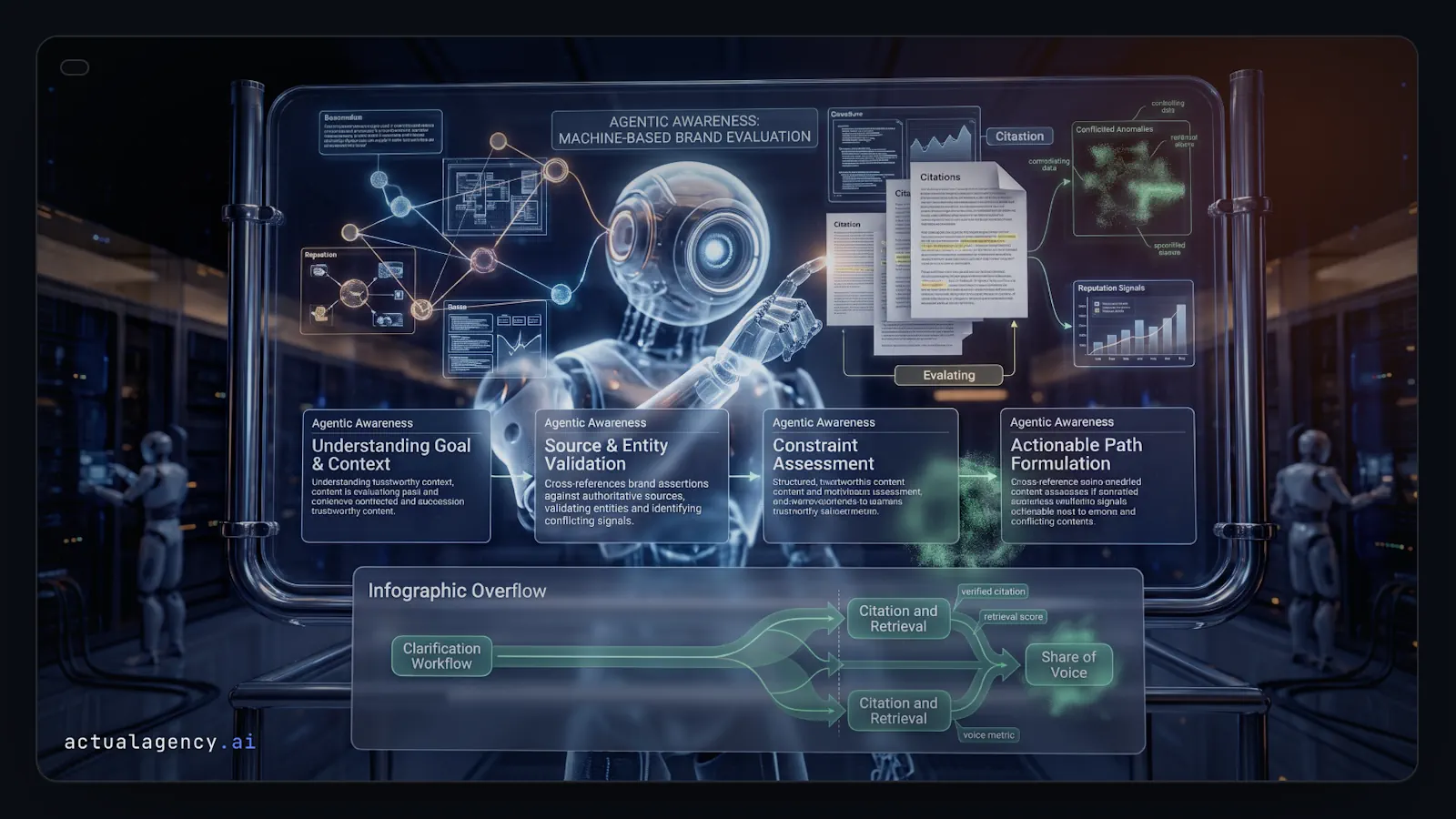
Agentic awareness is a practical framework for understanding how AI agents interpret goals, context, entities, sources, constraints, and possible actions during discovery. In AI search, your brand is evaluated by machines that assemble answers, not just rank links. Treating AI as an audience clarifies what evidence, structure, and consistency those systems need to understand and trust your content.
Discovery is shifting from human-mediated search to machine-mediated evaluation. A growing share of buyers now begin with AI, and shortlists form before sales teams ever engage. That makes clarity, proof, and distribution essential. This article defines agentic awareness, distinguishes it from related concepts, shows how agents work across multi-step retrieval, and outlines the signals, workflows, and safeguards that help your information get understood and cited without overpromising outcomes.
Key Takeaway
- 35% of U.S. consumers start discovery with AI tools, while 13.6% begin with traditional search, shifting where brands must be visible Similarweb Tryellmo
- AI Overviews drive zero-click behavior up to 69%, concentrating clicks on cited sources Similarweb
- Top sites average only 55% on Cloudflare’s Agent Readiness Score, signaling broad technical gaps for machine access Nurul Nahid
Defining Agentic Awareness
Agentic awareness is the strategic understanding of how AI agents interpret goals, context, entities, sources, constraints, and actions when they search for and use information. It is an emerging framework, not a universal standard, used by marketers, publishers, and product teams to align information with how agents evaluate and act.
Agentic awareness addresses system behavior and interpretation, not consciousness. It focuses on how an AI detects cues, decomposes tasks, retrieves evidence, and simulates next steps. Actual Agency frames this as the age of agentic awareness, where algorithms interpret a company before a human buyer does Actual Agency. In cybersecurity, Scan0 positions an Agentic Awareness Layer to continuously evaluate agent activity and supply chain drift Scan0.
Example scenario: a user asks an AI assistant to identify a suitable marketing agency. The agent parses the goal, retrieves candidate firms, checks service scope, industries served, and proof points, compares options, and returns a cited short list. The evaluation hinges on clear entities, structured evidence, and consistent claims across sources.
The Importance of Agentic Awareness in AI Search
AI search often moves from retrieving links to interpreting a task, assembling a response, and sometimes recommending a next action. Visibility depends on whether a system can understand, verify, attribute, and apply your information within that task.
Behavior has shifted. 35% of U.S. consumers start discovery with AI tools, while 13.6% start with traditional search engines Similarweb Tryellmo. In B2B, 95% of deals are won from shortlists formed before contacting sales, intensifying the need to be correctly understood early Chief Outsiders.
AI Overviews increase zero-click behavior from 56% to 69%, so fewer queries result in open web visits, and cited sources capture outsized share Similarweb. A trust gap persists, with 54% of users still preferring manual search due to hallucination concerns Tanja Gavrilovic. Brands that pair human-first clarity with machine-readable proof improve the odds that agents can retrieve and cite their content accurately.
Distinctions Between Agentic Awareness and Related Concepts
These ideas overlap but are not interchangeable. Treat agentic awareness as the strategic lens for how agents perceive, verify, and act on information across tasks and surfaces.
Core distinctions at a glance
| Term | What it is | Primary goal | Typical outputs | Not the same as |
|---|---|---|---|---|
| Agentic AI | Autonomy tech | Plan and act | Multi-step tasks | Strategy lens |
| AI agents | Software actors | Execute tasks | Tool use, actions | SEO tactic |
| AI search | AI-driven search | Interpret, answer | Synthesized results | Classic SERP only |
| SEO | Discovery practice | Rank pages | SERP listings | Agent behavior model |
| GEO | GenAI visibility | Earn citations | Answer mentions | Full task modeling |
| Agentic Awareness | Strategy lens | Be machine-usable | Verifiable signals | Old school PR |
Agentic AI refers to systems that can reason, plan, and act toward goals; agentic awareness is the human strategic understanding of how those systems interpret and use information Dean on Delivery. Generative Engine Optimization focuses on being represented inside AI answers, while agentic awareness informs how to make information verifiable and actionable across multi-step workflows Similarweb.
Agentic Awareness in Practice
Agents often run loops: decompose a goal, query, read, compare, detect gaps, reformulate, then synthesize. Google and NYU’s SAGE framework shows complex queries average 4.9 search steps per question, not one-and-done retrieval Similarweb. Agentic RAG (Retrieval-Augmented Generation) patterns route queries, evaluate relevance, and only then generate an answer Decagon Algolia.
Scenario 1: Finding a marketing agency
- Goal interpretation: understand industry, budget constraints, and outcomes requested.
- Context gathering: scan brand site, third-party profiles, and reviews.
- Entity recognition: agency names, services, locations, notable clients.
- Retrieval: fetch service pages and case evidence.
- Source evaluation: prefer dated case studies, named clients, verified authors.
- Synthesis: compare 3 to 5 options with citations.
- Action: draft outreach email or book a call.
What the agent needs to understand about your firm: what you do, who you serve, where you operate, verified results with dates, and how your offer maps to the user’s need. Factual interpretation is separate from the recommendation; the agent can summarize accurately yet still advise a cautious next step.
Scenario 2: Shortlisting a B2B SaaS vendor
- Goal interpretation: align on security needs and integrations.
- Context gathering: read docs and roadmaps.
- Retrieval: pricing, SOC attestation pages, and API references.
- Evaluation: prefer machine-readable specs and change logs.
- Synthesis: tabular comparison with documented tradeoffs.
- Action: create a procurement checklist.
Across both scenarios, multi-step loops and source checks dominate. Absent structure or proof, your page is skipped in favor of verifiable alternatives Decagon Algolia.
Key Signals for AI Agent Comprehension
Agents prioritize factual, structured, and verifiable signals over promotional copy. Vague claims like fast shipping lose to concrete, machine-readable details like delivery by Oct 24 with source corroboration Parcel Perform.
Focus on:
- Clear, consistent entity descriptions: organization, products, services, audiences, locations
- Direct answers near the top of pages, with supporting evidence and dates
- Transparent authorship, publication and update dates, and meaningful revisions
- Consistent terminology across site and credible third parties
- Structured content: descriptive headings, lists, tables, internal links, stable URLs
- Accurate structured data that reflects visible content
- Methodology, examples, limitations, and citations
- Technical accessibility and performance, monitored over time
Readiness is lagging. The top 100 websites average only 55% on Cloudflare’s Agent Readiness Score, indicating widespread machine-access gaps Nurul Nahid. Specialized, well-structured content can outperform larger brands in AI citations when it offers cleaner signals Similarweb.
Building an Agentic Awareness Strategy
Adopt AI-native operations that align product marketing, PR, CX, and security. Unify Clarity, Proof, and Distribution so every surface tells the same verifiable story. Treat human-in-the-loop as mandatory, not optional.
A practical program:
- Inventory entities and terminology: company, offers, experts, locations, and distinctive concepts
- Map user tasks and questions, not just keyword variations
- Write answer-first definitions, then add context, evidence, and limits
- Build content clusters that link foundational explainers to deep-support pages
- Make claims verifiable with primary sources and dated updates
- Standardize naming across owned and trusted third-party profiles
- Test several AI search systems and document inaccuracies or omissions
- Create review gates for factual accuracy, brand representation, privacy, and high-stakes advice
Feedback matters. In IT service agents, initial analyst rejection rates around 27% fell to 9% to 16% as teams tightened constraints and oversight Fixify.
Agentic Awareness and AI Search Visibility
Yes, it improves conditions that help systems understand, retrieve, and attribute your content, but it cannot guarantee rankings, citations, or recommendations. Visibility depends on retrieval design, source quality, query context, model behavior, freshness, and competition.
AI Overviews reduce organic CTR (Click-Through Rate) by 61% for non-cited brands, while cited brands see 35% more organic clicks, concentrating demand on attributed sources Similarweb. AI referral traffic contributes a meaningful share of qualified pipeline, reaching up to 19% QuickSEO.
Measure across a bundle: citation frequency, source attribution, factual accuracy of summaries, brand representation quality, and referral traffic. Separate visibility from actionability: being mentioned is not the same as being selected for a recommendation or task.
Limits and Risks of Agentic Awareness
Agents can misread ambiguous language, lean on incomplete evidence, or merge sources incorrectly. They also produce confident but wrong answers and may omit citations.
Users notice. 54% still prefer manual search due to hallucination and citation concerns Tanja Gavrilovic. Platform-level rejections occur for ethics and safety, with about 9.0% of user requests declined in some agentic environments First Page Sage. Organizationally, more than 40% of enterprise agentic AI projects are expected to be canceled by the end of 2027, reflecting cost and risk-control gaps First Page Sage.
Avoid manipulation, fabricated consensus, or keyword stuffing. Protect personal data, respect access controls, and apply human review to consequential outputs. Treat AI interpretations as hypotheses to evaluate, not definitive measures of public perception.
Getting Started with Agentic Awareness
Checklist you can act on now:
- Define entities and terms precisely; keep them consistent across owned and third-party profiles
- Understand user tasks; answer priority questions directly near the top of pages
- Show evidence with dates, authorship, and methods; link to primary sources where possible
- Structure information with clear headings, lists, tables, internal links, and accurate structured data
- Monitor how multiple AI systems interpret your brand; log errors, omissions, and drifts
- Improve based on gaps; add missing facts, fix contradictions, and standardize naming
- Strengthen the technical layer; test agent readiness and page performance over time Nurul Nahid
- Shift KPIs toward Share of Model and citation overlap; track answer accuracy alongside traffic Similarweb
Content built for agents should be useful to people first: specific, organized, transparent, current, and well-cited. For a deeper perspective on AI search and brand visibility, explore resources from Actual Agency Actual Agency.
Conclusion
Agentic awareness helps brands align information with how AI systems interpret goals, gather context, verify sources, and act. The shift to machine-mediated evaluation rewards clarity, proof, and distribution. Use multi-step-friendly structures, publish verifiable evidence with dates and authors, fix contradictions across surfaces, and maintain human oversight to curb drift and errors.
Next steps: run a trust-signal audit, strengthen technical accessibility, standardize entities, and benchmark your Share of Model and citation overlap. If your CMS supports it, add Article schema for the post, FAQPage schema when the visible Q&A qualifies, and BreadcrumbList schema if navigation supports it. When you are ready to operationalize these practices, explore Actual Agency’s broader perspective on AI search.
Frequently Asked Questions About Agentic Awareness
- What is agentic awareness in simple terms?
- Agentic awareness is a practical framework for understanding how AI agents interpret goals, gather context, evaluate sources, and use information during discovery. It helps brands make their information clearer, verifiable, and useful to those systems.
- Is agentic awareness the same as agentic AI?
- Agentic AI refers to technology that can plan and act toward goals. Agentic awareness is the human strategic understanding of how those systems interpret and use information.
- How does agentic awareness affect SEO?
- It extends the focus beyond rankings and clicks to how AI systems retrieve, evaluate, and apply information across multiple steps. Clear descriptions, accessible content, and supporting evidence help systems interpret a brand accurately.
- What is the difference between agentic awareness and generative engine optimization?
- Generative engine optimization focuses on a brand’s representation and citations in AI-generated answers. Agentic awareness also considers how agents verify information and use it to compare options, make recommendations, and complete tasks.
- How do AI agents decide which sources to use?
- Source selection varies by system and task. Relevant information, clear entity descriptions, dated evidence, transparent authorship, and corroboration can help agents evaluate a source. These signals do not guarantee selection or citation.
- Can businesses optimize for agentic awareness?
- Yes. Businesses can clarify their services and audiences, support claims with evidence, improve technical accessibility, and keep information consistent across sources. Testing how AI systems describe the business can reveal gaps that need human review.
- Does agentic awareness mean AI systems are conscious?
- No. In this framework, awareness refers to how systems interpret context and information. It does not imply consciousness or sentience.
- How can a brand measure its visibility in AI search?
- Track citation frequency, source attribution, the accuracy of AI-generated summaries, brand representation, and AI referral traffic. Test a consistent set of relevant questions across several systems and distinguish being mentioned from being recommended.