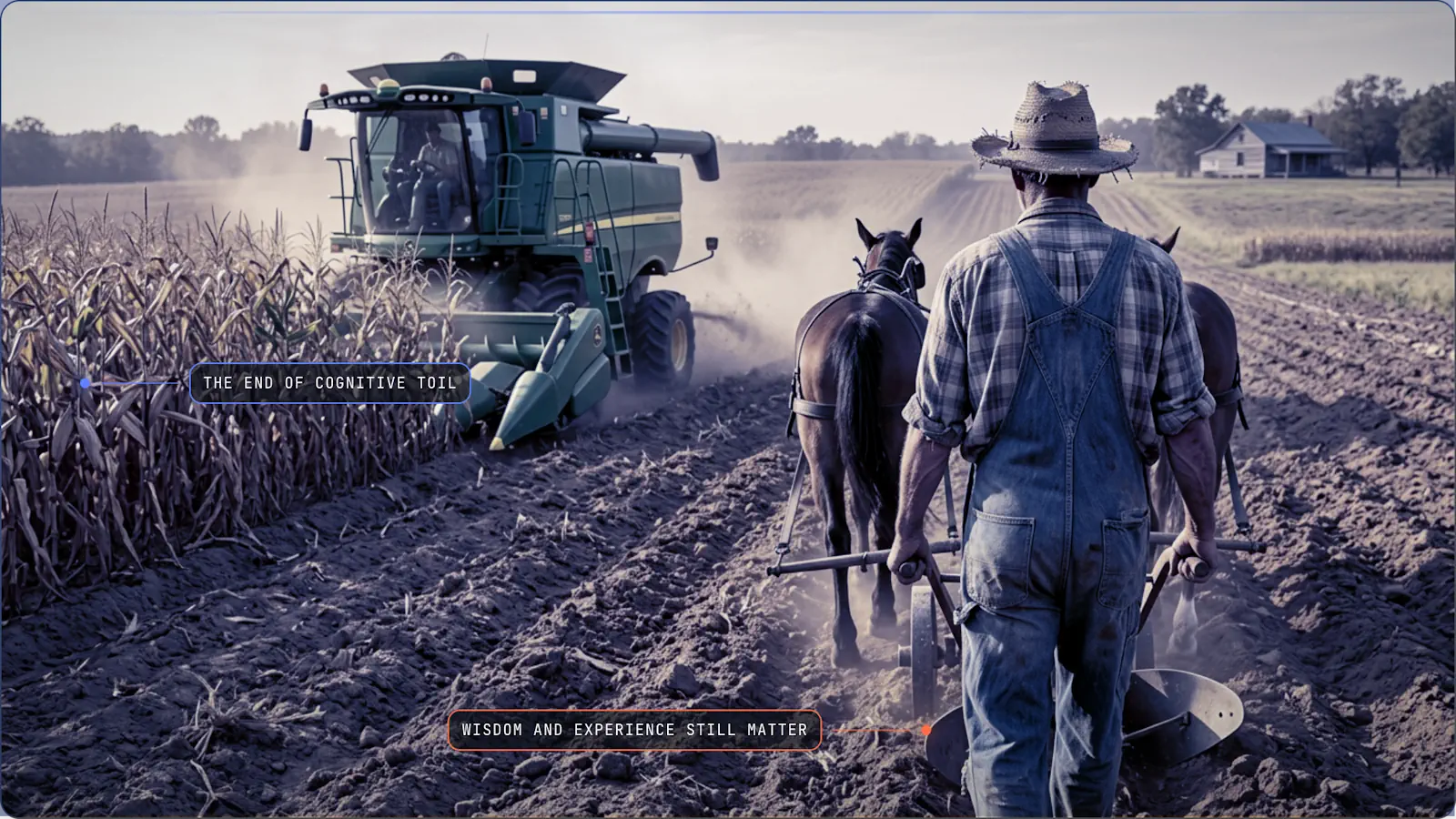
At every point of technological change the old way of working did not become wrong. It just became unnecessarily expensive and contrary to human flourishing.
The jump from a horse-drawn plow to mechanized farming captures that moment. The goal and the outputs of farming did not change. What did change was a massive reduction in human toil. The freeing of millions from a life of grinding repetitive work that machines were built to absorb.
I will argue here that Comms has reached its own version of mechanization. What is on the other side of it is not replacing the human practitioner. We still have farmers, after all. But to give those practitioners an escape from cognitive toil toward a fuller use of human creative power.
Corporate communications was built around managing a relatively stable environment. There were journalists, publications, analysts, events, employee channels, investor audiences, customers, and perhaps a handful of social platforms. The job was difficult, but the system had recognizable pathways and rhythms. An organization could develop a message, identify the relevant intermediaries, place it in the appropriate channels, monitor reaction, and adjust.
Now, corporate narratives move through a complex, recursive, and computational-centered environment. A brand narrative can be clipped, reframed, translated, summarized, fact-checked, remixed, surfaced by search, ingested into LLMs, and reintroduced to audiences through an AI- answer engine before the Comms team has completed its daily media scan. A story meant for humans is interpreted by AI systems, search indexes, retrieval engines, social graphs, data brokers, news aggregators, and autonomous AI crawlers of every description.
Narrative is not merely transmitted. The public may encounter a company through a journalist’s article, a creator’s interpretation, an employee’s post, a customer review, an analyst report, a Wikipedia entry, a Reddit thread, a regulatory filing, or an AI answer that compresses all of those sources into a few confident sentences. The organization may not control any of these surfaces. In many cases, it may not even know which sources shaped the conclusion.
This is a profound change.
A company’s brand narrative is becoming a computational output: a probabilistic synthesis generated from many signals across the information landscape. The company’s own website and messaging are still primary inputs. There is independent reporting, historical coverage, executive behavior, customer sentiment, external data, industry commentary, controversy, and the credibility of sources that corroborate or contradict the company’s claims.
In this environment, communications cannot be understood solely as content production, media relations and stakeholder engagement. It becomes the management of an organization’s narrative architecture.
Enter agentic awareness
By “agentic awareness,” I mean an organization’s ability to understand the ways in which autonomous and semi-autonomous systems participate in the discovery and explanation of the organization’s brand narrative.
AI systems do not just distribute corporate information. They make probabilistic choices. They choose which sources to retrieve. They choose which facts appear salient. They choose which company is mentioned in a category answer, which controversy is included in a summary, which executive quote represents a business, and which historical claim has enough corroboration to be treated as true. They may compare competing companies, recommend products, summarize earnings, explain litigation, draft internal briefings, answer investor questions, or help a journalist frame a story.
In each of those cases, the AI system is not a passive channel. It is an intermediary with some degree of interpretive power.
That does not mean AI systems are conscious, neutral, or reliably correct. They are none of those things. Their outputs depend on model design, retrieval methods, source availability, recency, prompt wording, platform incentives, and the uneven quality of the underlying web. They can hallucinate. They can overstate. They can reproduce biases embedded in their data. They can flatten nuance into false certainty.
But the fact that these systems are imperfect does not lessen their relevance. It makes the need for an advanced organizational use of computational communications all the more urgent.
The communications leader must now ask questions that would have sounded exotic only a few years ago:
What does AI say when a prospective customer, investor or employee asks about us?
- Which third-party sources are being cited?
- Do those sources reflect our current strategy, or are they an outdated version of the company?
- Are our category claims independently substantiated?
- How consistently are our leadership, products, competitors, and risks being represented?
- Where do agentic conclusions and summary diverge from the story we believe we are telling?
These questions need to be answered strategically, structurally and consistently across multiple surfaces.
This is the move to computational communications
I come not to bury public relations, but to praise and extend it.
The scope of understanding about Comms must include the discipline of designing, observing, and improving how organizational narratives behave across the machine-mediated information landscape.
Public relations has always involved relationship-building, editorial judgment, stakeholder management, crisis response, persuasion, and the difficult work of establishing trust. Computational communications preserves this foundation. But it adds a new operating layer: an understanding of how machine systems parse, retrieve, score, summarize, connect, and circulate information about an organization.
This is not an argument for turning communications over to engineers, although their thinking and input is vital to this transformation. Nor is it an argument for treating every corporate utterance as an optimization problem. The opposite is true. It is an argument for protecting the distinctly human parts of the work by using machines to handle the scale, repetition, fragmentation, and observation burden that consumes communicators’ time. Computational communications serves to mitigate the needless toil we face in managing corporate reputation in the agentic age.
The environment is now too dense.
No individual can continuously monitor every relevant media outlet, social network, creator ecosystem, policy development, competitor move, search result, customer conversation, executive mention, synthetic narrative, and emerging misinformation vector. No team can reliably read and compare the thousands of small narrative signals that accumulate around a major company every day. And no organization should ask talented people to spend their highest-value cognitive hours performing work that machines can do faster: routine synthesis, tagging, transcription, translation, source classification, issue clustering, anomaly detection, repetitive drafting, and basic monitoring.
The old model asks people to walk behind the plow.
Computational communications asks: where should we deploy the harvester?
But automation is not the goal
The shallow version of this conversation is about efficiency: use AI to write more drafts, generate more pitches, produce more social posts, summarize more meetings, and reduce the cost of content. This seems to be where much of the AI tooling that has come to be identified as the new AI-PR stack.
Those uses may be practical. But they are not transformative.
If communications uses AI only to increase the volume of mediocre material entering an already saturated information ecosystem, it will intensify the very problem of destroying human cognitive freedom. More generic content is not more communication. More automated outreach will not deliver more coverage. More messages do not create more meaning.
Much of the AI industry conversation is pointed toward automation of human cognitive labor, when we should be talking about the emancipation of the human creative thought space. The real promise of machine support is not production at scale.
Machines are best when they take on the repetitive, exhaustive, and computationally demanding work that drains attention without requiring deep human judgment. They can detect patterns before they become crises, map issues across fragmented audiences, monitor competitive communications, track information provenance, identify gaps between corporate claims and external understanding.
Creating first drafts of media pitches is not what we should be using AI systems for. Freeing humans from toil is what machines are best at.
Humans can determine whether a message is wise rather than merely coherent. They can read the emotional undertow of stakeholder relationships. We can recognize when a technically factual statement is morally hollow. We can decide what an organization should say when facts are incomplete and consequences are real. We can hold conflicting truths at once. We can build trust through accountability, presence, humility, and judgment.
These are not inefficiencies to automate away. They are the fragile and precious forms of human cognitive and creative energy that no neural network can predict.
Developing a narrative system.
The practical shift is from managing a pipeline of communications activities to managing a dynamic narrative system.
Communications teams need fluency in prompt engineering, data structures, source quality, retrieval behavior, knowledge graphs, semantic consistency, model limitations, platform incentives, and measurement design. They will need closer working relationships with marketing, product, legal, investor relations, IT/security, customer experience, and policy teams.
Comms is uniquely positioned to help the organization establish a clear division between what machines should do and what must remain human-led.
The new communications dashboard
In the age of agentic awareness, the communications audit must expand.
The traditional audit maps coverage, sentiment, message pull-through, share of voice, stakeholder perceptions, and competitive positioning. Those remain essential. But a computational audit must also examine how the organization exists across machine-readable environments.
Comms must test how major AI systems answer category-level questions, competitive comparisons, reputation queries, product questions, executive questions, employee questions, and crisis-related prompts. It should identify the sources most frequently used to support answers. It should track where the company’s own language is contradicted, where information is stale, and where unverified narratives have become structurally persistent.
A company can be visible in AI-generated answers for the wrong reasons. It can be accurately represented but absent from high-value category conversations. It can have strong owned content but weak third-party corroboration. It can dominate attention while suffering from an incoherent or brittle narrative footprint.
The goal is not to “game” AI systems. Any short-term manipulation strategy will be brittle, and it will collapse under scrutiny. The goal is to make an organization’s actual reality legible: clear claims, reliable facts, credible evidence, consistent entity information, meaningful third-party validation, and rapid correction when the information environment fails to reflect the truth.
A discipline built on stewardship
Computational communications can be understood as stewardship at scale.
Its purpose is not to help corporations manufacture consensus through more sophisticated automation, but to help navigate an environment in which attention is fragmented, information is abundant, and machines increasingly mediate the relationship between organizations and the people they are trying to reach.
That demands discipline.
It demands that organizations treat factual accuracy as infrastructure, not legal cleanup. It demands governance around AI use, especially where private data, employee information, high-stakes stakeholder communications, and reputational risk are involved. It demands transparency about when AI has meaningfully shaped public-facing material. It demands investment in trusted human expertise rather than a race to replace it.
Most importantly, it demands that communications leaders stop treating technology as a peripheral toolset.
The communications function is becoming more intense because the world it serves is more intense. The number of narrative surfaces has multiplied. The pace of reputational change has accelerated. The distinction between information, opinion, manipulation, and synthetic media is harder for audiences to assess. The demand for response has become continuous.
We cannot meet that environment by asking more of people whose cognitive powers are being overrun by too many signals across an expanding array of surfaces.
The horse-drawn plow did not make the farmer less human. The harvester gave the farmer a different relationship to the field, and the ability to grow more and feed more people.
I believe, computational communications can do the same for communicators. It can shift the profession away from endless reactive production and toward its highest purpose: helping organizations to land their narratives, and earn the trust that no machine can generate on their behalf.
Say hello: mby at actual dot agency.
# # #
Questions, answered.
- What is agentic awareness?
- Agentic awareness is an organization's ability to understand how autonomous and semi-autonomous systems participate in the discovery and explanation of its narrative. AI systems do not simply distribute information. They choose which sources to retrieve, which facts look salient, which company appears in a category answer, which controversy makes the summary, and which claim has enough corroboration to be treated as true. That interpretive power makes them intermediaries rather than channels.
- What is computational communications?
- Computational communications is the discipline of designing, observing, and improving how organizational narratives behave across the machine-mediated information landscape. It keeps everything public relations already does well: relationship-building, editorial judgment, stakeholder management, crisis response, and the slow work of earning trust. On top of that foundation it adds an operating layer, an understanding of how machine systems parse, retrieve, score, summarize, and circulate information about a company.
- Does this mean AI replaces communications professionals?
- No. Mechanization did not end farming, and it will not end communications practice. The argument is the reverse: use machines to absorb scale, repetition, fragmentation, and the observation burden so that human attention returns to the work only humans can do. Humans judge whether a message is wise rather than merely coherent, read the emotional undertow of stakeholder relationships, recognize when a technically accurate statement is morally hollow, and decide what to say when the facts are incomplete and the consequences are real.
- Is the point of AI in Comms to produce more content faster?
- No, and that is the shallow version of the conversation. More drafts, more pitches, more automated outreach, and more generic material only intensify the saturation problem. If communications uses AI mainly to increase volume, it will add noise to an already crowded information ecosystem without adding meaning. Machines earn their place on pattern detection, issue clustering across fragmented audiences, competitive monitoring, information provenance, and finding the gaps between what a company claims and what the market understands.